Verified Electronics vs Win-Source: Which Is Better for Tested Components?
Compare Verified Electronics and Win-Source on testing, traceability, price, and support. Learn how component shelf life and date codes affect your choice.
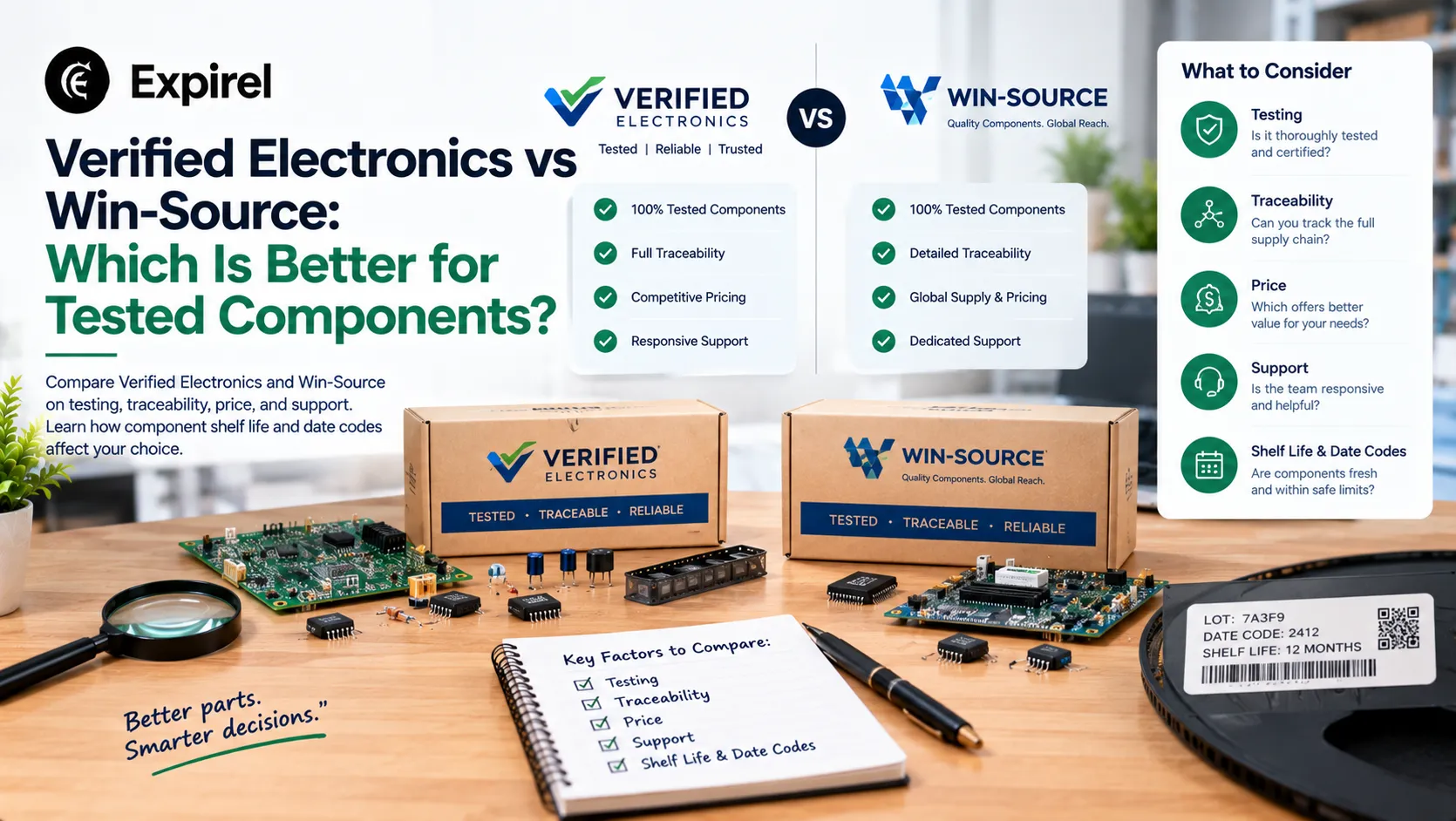
Quick answer: For tested, traceable components, Verified Electronics is the stronger fit. The company says it sends open-market parts to accredited third-party labs and provides inspection reports before purchase. Win-Source suits small, quick, low-cost orders that don't require full lab documentation.
Both companies are independent distributors, and both list a huge range of parts. The real difference is how each one proves a part is genuine, and who each one is built to serve.
There is a second question that buyers often forget: how old is the part? Electronic components do not spoil like milk, but many have a shelf life, a date code, and handling limits. This guide compares the two distributors and shows you how to track those time limits, so you do not install a part that sat too long on a shelf.
What is an independent distributor, and why does it carry risk?
An independent distributor buys parts on the open market instead of directly from the manufacturer. Buyers turn to them when a part is obsolete, on long lead times, or out of stock at franchised channels.
That flexibility has a cost. Open-market stock can include counterfeit, recycled, or badly stored parts. A U.S. Department of Commerce assessment published in 2010 found that 39% of surveyed organizations had met counterfeit electronics during its four-year study period. The data is older, but it is still widely cited, and it explains why buyers ask for proof.
So the useful question is not "who has the part?" It is "how does this seller prove the part is real, and what do I know about its age and storage?"
Verified Electronics vs Win-Source at a glance
Feature | Verified Electronics | Win-Source |
|---|---|---|
Headquarters | UK | Shenzhen, China |
Parts listed | 1 million+ | Large online catalog |
Testing method | Accredited third-party labs | Mainly in-house inspection |
Lab standards | AS6081, AS6171, AS5553, CCAP-101, IDEA-1010 | Ask before ordering |
Test report before purchase | Yes, on request | Not always for small orders |
Samples | Available | Varies |
Traceability | Lot, date code, and supplier history | Varies by listing |
Quality certification | ISO 9001:2015 | Check current status |
Sales support | 24 hours: US, UK, EU, Asia | Online, China-based team |
Obsolete parts | Yes, including 20+ years obsolete | Yes |
Excess inventory buying | Yes | Yes |
Ordering style | Quote-based, testing included | Online cart with listed prices |
Comparison details come from public information and data supplied by Verified Electronics. Company policies change, so confirm current terms on each company's website before you order.
Testing and quality: which distributor proves parts are genuine?
Verified Electronics is stronger here. This is the biggest gap between the two companies.
How Verified Electronics tests parts
According to the company, Verified Electronics sends parts to accredited outside labs instead of grading its own stock. Independent testing removes the conflict of interest that exists when a seller inspects what it sells. Typical tests include:
Visual inspection to find remarked, sanded, or re-plated parts
X-ray to check internal structure and bond wires
Decapsulation and die analysis to confirm the real manufacturer's die
Electrical checks to confirm the part performs to its datasheet
How Win-Source approaches quality
Win-Source mainly relies on its own inspection, based on the information available. Public forum threads, including discussions on EEVblog, show buyers asking whether Win-Source parts are reliable. Many report fine results. Still, without independent proof, you are trusting the seller's word.
Practitioner's note: A visual check catches only crude fakes. Modern counterfeits can look perfect on the outside, which is why die analysis and electrical testing matter for critical parts.
What do the lab standards mean?
Buyers often see these acronyms without a clear explanation. In plain terms:
AS6081 sets counterfeit-avoidance practices for distributors. SAE International notes that an updated version, AS6081A, was issued in April 2023.
AS6171 defines test methods for detecting suspect or counterfeit electronic parts.
AS5553 covers counterfeit-avoidance practices for buyers and purchasers.
CCAP-101 is a certification program for independent distributors.
IDEA-1010 is an inspection standard for electronic components.
For short definitions of other industry terms, the ERAI glossary is a useful reference. When a distributor lists these standards, ask which ones apply to your order. A long list on a website is not proof. A test report that cites the standard is.
Do electronic components expire? What buyers should know
Electronic parts rarely carry a printed "use by" date, but time still matters. Age and storage affect whether a part is safe to use. This is where traceability and testing meet shelf life.
Part type | What can go wrong over time | What to check |
|---|---|---|
Moisture-sensitive ICs | Absorbed moisture can damage the package during reflow soldering | Moisture sensitivity level, bag seal date, and how long the bag has been open |
Electrolytic capacitors | Performance can drift after long storage | Date code and the maker's storage guidance |
Batteries | Capacity falls during storage | Production date and datasheet shelf life |
Any old stock | Leads can oxidize, which hurts solder joints | Date code, storage history, and test results |
Moisture-sensitive chips are the clearest example. The joint IPC/JEDEC standard J-STD-033 sets handling rules for them. It defines a floor life, which is the time allowed between opening the dry-pack bag and soldering. The dry-packing process it describes gives a minimum shelf life of 12 months from the bag seal date, as long as the bag stays sealed and undamaged.
Always read the manufacturer's datasheet for exact limits. Rules differ by part type and maker.
Traceability: which distributor documents a part's history?
Verified Electronics is stronger here. The company says it traces every part by lot, date code, and supplier history, and that its suppliers go through a formal approval process and follow customer flow-down requirements.
This matters for two reasons. First, auditors in regulated fields ask where a part came from. Second, the date code lets you judge age. A part with a date code from many years ago is not automatically bad, but it needs testing and proof of good storage. With Win-Source, traceability varies by listing, so confirm what paperwork comes with each part before you pay.
Price and convenience: which one is easier to buy from?
Win-Source is stronger here. It shows prices online, and you check out like any web store. For a few low-cost parts, that is fast and simple. Its large catalogue also makes searching easy.
Verified Electronics works on quotes. You wait for pricing, which can slow down urgent small orders, but the quote includes testing. Compare total cost, not unit price. A cheap part that fails in the field costs far more than the savings.
Support: who can you reach during your working day?
Verified Electronics is stronger here for Western buyers. It lists US and UK phone lines and 24-hour sales coverage across the US, UK, EU, and Asia, so buyers can reach a person during their own working day. Win-Source runs an online, China-based team, which can mean different reply times across time zones. Check its current support hours.
Which distributor should you choose?
Choose Verified Electronics if you:
Build medical, aerospace, defence, automotive, or industrial products
Need test reports for audits or customers
Buy high-value parts such as FPGAs or processors
Want a UK or US time-zone contact
Choose Win-Source if you:
Need a few cheap parts quickly
Are building a prototype or hobby project
Do not need formal test documentation
Real-world scenarios
Medical device repair. A manufacturer needs a discontinued controller for a device already in hospitals. A failed part is a safety issue, and the auditor will ask for records. Lab-tested stock with lot and date-code traceability is the safer path.
Weekend prototype. A hobbyist needs ten common capacitors for a test board. If one fails, the cost is a few dollars. A fast online cart is a reasonable fit.
Aging industrial line. A factory needs a chip that went obsolete 20 years ago to keep a production line running. Old stock has the highest counterfeit and storage risk, so independent testing and a clear date code matter most here.
How to track component shelf life after you buy
Good sourcing is only half the job. Parts can age in your own stockroom too. A simple tracking routine prevents waste. The steps below use an expiry tracker such as Expirel, which is built for tracking dates and reminders.
Record the key dates on arrival. Note the date code, lot code, bag seal date, and the date you opened the bag.
Turn the time limit into an expiry date. Use the end of shelf life or floor life from the datasheet as the item's expiry date. Name the item by part number and batch.
Add items fast. The barcode scanner saves typing when labels carry a scannable code.
Set reminders before the deadline. Pick a reminder window that fits your lead time, such as a week or a month ahead. Multi-channel alerts reach you by email or WhatsApp.
Share the list with your team. Stores and purchasing staff should see the same dates. Business features support larger inventories and teams.
Review what expired. The analytics dashboard shows waste patterns, which helps you order smaller, fresher lots next time.
A fair limit: An expiry tracker is not a full inventory or ERP system. For a large production line, use it as a simple date-alert layer next to your main system. For a small lab, repair shop, or maker space, it may be all you need.
A 7-point checklist for vetting any independent distributor
Ask who tests the parts. Prefer an accredited third-party lab over in-house checks.
Request a sample report first. A confident seller shares one without friction.
Confirm the standards. Ask which of AS6081, AS6171, and AS5553 apply to your order.
Check traceability. Ask for lot code, date code, and supplier history.
Ask about storage and age. Request the date code and how the stock was stored.
Verify certifications. Look for current ISO 9001 status and ask for the certificate.
Read return and warranty terms. Know what happens if a part fails testing.
Common mistakes buyers make
Choosing on unit price alone. Testing and traceability are part of the real cost.
Treating a visual check as full testing. It only catches obvious fakes.
Ignoring the date code. Age and storage affect solderability and reliability.
Opening moisture-sensitive bags too early. The floor-life clock starts when the bag opens.
Relying on one forum review. Forums help, but they are not documentation.
Collecting records after the audit starts. Save reports at purchase time.
Final Thoughts
Win-Source is a convenient online store for quick, low-cost buys. Verified Electronics is built for buyers who need documented testing and traceability. If a failed or fake part would cost you more than the part itself, independent testing is worth the extra step, and Verified Electronics fits that need. Whichever you pick, record the date code and track shelf life once the parts reach your shelf.
Frequently asked questions
Q: Is Verified Electronics better than Win-Source?
For buyers who need independent testing and traceability, it is the stronger fit. It states that it uses accredited labs and offers reports before purchase. For small, low-risk orders, Win-Source may be enough.
Q: Is Win-Source cheaper than Verified Electronics?
Often for small orders. Verified Electronics quotes include third-party testing, so compare total risk, not only unit price.
Q: Which is better for obsolete parts?
Both source obsolete parts. Independent lab testing, which Verified Electronics offers, matters most for old stock.
Q: Where is Verified Electronics based?
In the UK, with sales support covering the US, UK, EU, and Asia.
Q: Do electronic components have an expiry date?
Most parts have no printed expiry date, but many have a shelf life or floor life. Moisture-sensitive chips, batteries, and some capacitors are the main examples. Check the datasheet and the date code.
Q: What is a date code on an electronic component?
It is a short code that shows when the part was made. Many makers use a year-and-week format, but formats vary, so confirm with the manufacturer.
Q: Do I need test reports for every order?
Not always. For cheap, common parts in a prototype, you can skip them. For regulated, high-value, or safety-related parts, request them.

Fahad Ahmad
Founder of EXPIREL · Digital Entrepreneur · Product Management Specialist
Fahad Ahmad is the founder of EXPIREL and a digital entrepreneur with over 10 years of experience in SaaS development, SEO, and digital product creation. He focuses on building practical solutions that help individuals and businesses manage product expiration dates, organize inventory, track habits, and improve daily productivity.
Through EXPIREL, Fahad shares actionable guides, product management tips, barcode scanning tutorials, and research-backed insights designed to help users reduce waste, stay organized, and make smarter decisions.
Related Articles
View all
AI Chatbot for Productivity: Complete 2026 Guide: Research, Pricing, and Which One Actually Works for You
September 29, 2026
Verified 2026 pricing, peer-reviewed research, and honest comparisons of the best AI chatbots for productivity, customer service, and website engagement.

Invideo vs. Runway: Which One Actually Fits the Way You Work?
September 15, 2026
Runway gives you control over one shot. invideo plans a whole sequence and can route to Runway. Here's how to pick the right level to work at.
Which Drugs Should Never Be Used Past Their Expiration Date
July 24, 2026
Not all expired medicine is equally risky. See exactly which drugs turn toxic or fail dangerously after their date, and what to do instead.