Can AI Story Videos for Kids Make Money on YouTube?
Can AI story videos for kids earn on YouTube? See partner program thresholds, made-for-kids limits, inauthentic content rules, and revenue math.
AI story videos for kids can make money on YouTube, but the AI is not what earns the money. Earnings depend on watch time, repeat viewers, audience location, the made-for-kids setting, and, above all, whether YouTube approves your channel for monetization. A channel that publishes original stories children enjoy has a real path. A channel that mass-produces near-identical episodes does not.
This guide explains what YouTube actually requires, how the made-for-kids label changes your income, what AI story tools can and cannot do, and how to test a channel before you expect profit. It is general information, not legal advice, so check YouTube's current rules and your local children's privacy laws before you publish.
What Does a Kids' Story Channel Need to Earn Money?
Four conditions decide whether a channel earns anything:
It meets YouTube Partner Program thresholds and passes review.
Its videos are original, with real variation from episode to episode.
It sets the correct audience (made for kids or not) and accepts the limits that come with it.
Viewers come back, which gives it watch time and repeat views.
What YouTube Requires Before You Can Earn Ad Revenue
Under YouTube's Partner Program rules, a channel needs 1,000 subscribers plus either 4,000 qualified public watch hours in the last 12 months or 10 million qualified Shorts views in the last 90 days. Reaching those numbers only makes you eligible to apply. YouTube then reviews the channel, and you also need two-step verification and no active Community Guidelines strikes.
The bar is about to rise. YouTube announced in August 2026 that from February 1, 2027, new applicants will need 8,000 qualified watch hours or 20 million qualified Shorts views, and the subscriber minimum stays at 1,000. Channels already in the program keep their status. Check YouTube Help for the latest figures before you plan your timeline.
Full ad revenue requirement | Until January 31, 2027 | From February 1, 2027 (new applicants) |
|---|---|---|
Subscribers | 1,000 | 1,000 |
Long-form watch hours (12 months) | 4,000 | 8,000 |
Or Shorts views (90 days) | 10 million | 20 million |
Shorts can bring in subscribers quickly, but Shorts watch hours do not count toward the long-form watch-hour requirement. Long episodes also give you room to tell a complete story, so many channels use Shorts to introduce characters and point viewers to full episodes.
How the Made for Kids Setting Changes Your Earnings
YouTube requires every creator to set an audience. YouTube's audience setting guide explains that content set as made for kids has limited data collection to comply with the Children's Online Privacy Protection Act (COPPA). YouTube does not serve personalized ads on that content, and it warns that this may reduce revenue for some creators. It also warns that setting the audience inaccurately can bring legal consequences.
The list of restricted features matters just as much for a story channel. Made-for-kids videos lose comments, notifications, cards and end screens, channel memberships and Super Chat, among others. So you cannot rely on fan funding, and you get less audience interaction to learn from. Plan for ad revenue that is contextual and likely lower, and build other income streams early.
How YouTube Judges AI Story Videos
YouTube reviews the whole channel, not one video. Its inauthentic content policy targets mass-produced or repetitive content, including videos made from a template with little variation and content that is easy to replicate at scale. The policy is about repetition and low value, not about using AI tools.
A repeated intro, recurring characters, and a consistent visual style are fine when every episode has its own plot. Problems start when stories repeat one situation with a few words changed, or when unrelated AI clips are stitched together with no narrative.
Use this quick check on every episode:
Safe signs: a clear problem, a different plot each time, original characters and your own script
Risk signs: the same story with new names, clips with no logic between scenes, famous characters copied, or unclear rights to music and voices
Disclosure is a separate rule. YouTube asks creators to disclose realistic AI content that a viewer could mistake for real. Clearly animated, unrealistic scenes do not need that label, and disclosing does not limit eligibility to earn money. Check the form at upload anyway, because the rules change.
Finally, keep records. Save license terms for any music, voices, images, or video that you did not create, because you may need them if a claim appears.
What AI Story Video Tools Do and Do Not Do
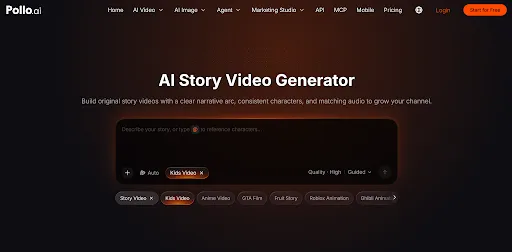
An AI story video generator turns a script, story idea or images into a multi-scene video with characters, backgrounds and motion. Pollo AI, for example, describes its generator as handling scene sequencing and style controls. Other tools, such as Pictory, also convert written stories into scenes with narration. These tools remove production steps, but they do not write a good story, choose a lesson or decide whether the pacing suits a four-year-old. Those decisions stay with you.
Some tools focus on short clips and effects instead. JoyFun AI, for example, is described on its own page as a tool for isolated short clips and effect templates. Check each tool's content policy before you use it for children's material, because some effect libraries include adult-oriented templates.
Tool type | Good for | Limit for kids' episodes |
|---|---|---|
Story-to-video generators | Multi-scene episodes with recurring characters | You still write, review and edit every story |
Short clip and effect tools | Single animated moments, Shorts teasers | No built-in story logic across scenes |
Manual editors | Full control over pacing and audio | More time per episode |
When you test any tool, check these points:
Do characters look the same across scenes?
Can you revise one scene without redoing the whole episode?
Is the narration clear for the age group?
Do the license terms allow commercial use on YouTube?
Does the content policy suit children's material?
A Simple Story Structure That Keeps Children Watching
Introduce the character and what they want in the first few seconds.
Present one clear problem. Skip long title sequences, because they give viewers time to leave.
Show two or three attempts to solve it, each one different.
End with a clear result. Let the lesson come from the character's choices, not from a sentence tacked on at the end.
Match the length to the story. Ten minutes stretched from a simple idea feels repetitive, and a long plot squeezed into one minute is hard to follow.
Keep characters stable. A cautious rabbit should not turn reckless without a reason inside the story. Keep music below the voice, and use sound effects to clarify actions, not to fill every second.
What Revenue Could Look Like
RPM means revenue per 1,000 views after YouTube's share. The formula is simple: views divided by 1,000, multiplied by RPM. The table uses made-up RPM values to show the range. These are examples, not predictions, and made-for-kids content may earn less because it has no personalized ads.
Monthly views | At $0.50 RPM | At $2.00 RPM |
|---|---|---|
100,000 | $50 | $200 |
500,000 | $250 | $1,000 |
1,000,000 | $500 | $2,000 |
The gap between rows shows why you should use your own YouTube Analytics data once the channel is monetized, not rely on averages from other channels.
Build the Channel Before You Expect Profit
Treat the first months as testing, not earning:
Pick one audience. For example, bedtime fables for ages four to six or simple adventures for early readers.
Publish five carefully reviewed episodes before you make fifty. Five tested stories teach you more than fifty near-copies.
Track four numbers: click-through rate, average view duration, audience retention, and returning viewers. A good thumbnail wins the click, and the retention graph shows whether the story keeps attention.
Review drop-off points and fix the pacing in the next episode.
Consistency decides most small channels. A weekly habit tracker helps you hold a weekly upload and review routine, and a few goal-setting apps can break the first 90 days into milestones. Also track your tool subscriptions and music or voice license renewal dates in an expiry tracker, so an expired license never puts old episodes at risk.
Revenue Beyond Advertising
Original characters and a consistent story world can support other income once you have a loyal audience:
Digital storybooks and printable activity sheets
Licensed character artwork
Sponsorships that follow the advertising rules for children's content in your country
These options need recognizable, original characters. Generic stories with changing casts offer little value outside YouTube, while a consistent world can grow into books and learning materials.
Common Mistakes With AI Kids' Story Channels
Publishing dozens of near-identical episodes. This is exactly what the inauthentic content policy targets.
Setting the audience wrongly. The audience setting has legal weight, so set it carefully for each video.
Copying famous characters. Create original ones instead.
Skipping review. AI can produce odd visuals or confusing plots, so watch every episode before you upload.
Expecting fast income. Thresholds are high and rising, and the first review may reject you.
Final Verdict
AI kids' story videos can make money on YouTube, but profit comes from the creative and business decisions, not the tool. AI reduces the work of scene creation, character continuity, narration, and audio. You still need original scripts, clear stories, careful review, and a publishing plan based on real audience data.
Start with one focused series, test a few complete episodes, and improve them using retention data. Revenue becomes possible when children keep choosing your stories, not when another automated video appears.
Frequently Asked Questions
Q: Can you monetize AI-generated kids' videos on YouTube?
Yes, if the videos are original, varied, and follow the monetization policies. YouTube's policy targets mass-produced or repetitive content, not AI use itself.
Q: How many subscribers and watch hours do you need?
Currently, 1,000 subscribers plus 4,000 qualified watch hours or 10 million Shorts views. For new applicants from February 1, 2027, YouTube has announced 8,000 watch hours or 20 million Shorts views.
Q: Does "made for kids" lower my YouTube earnings?
It can. YouTube does not serve personalized ads on made-for-kids content and warns that revenue may decrease for some creators. Comments, memberships, and several other features are also unavailable.
Q: Do I have to label AI-generated animated stories?
YouTube requires disclosure for realistic AI content that viewers could mistake for real. Clearly animated, unrealistic content generally does not need it. Check the upload form and current guidance.
Q: How long does it take to earn money from a kids' channel?
It varies widely. Plan for months of testing and publishing before you reach the thresholds, and expect the review to take additional time.