7 Best EHS Compliance Software for Safer Teams and Smoother Audits
Choosing EHS software shouldn't feel like guesswork. Compare 7 platforms on training, certification tracking, audits, and real setup trade-offs.
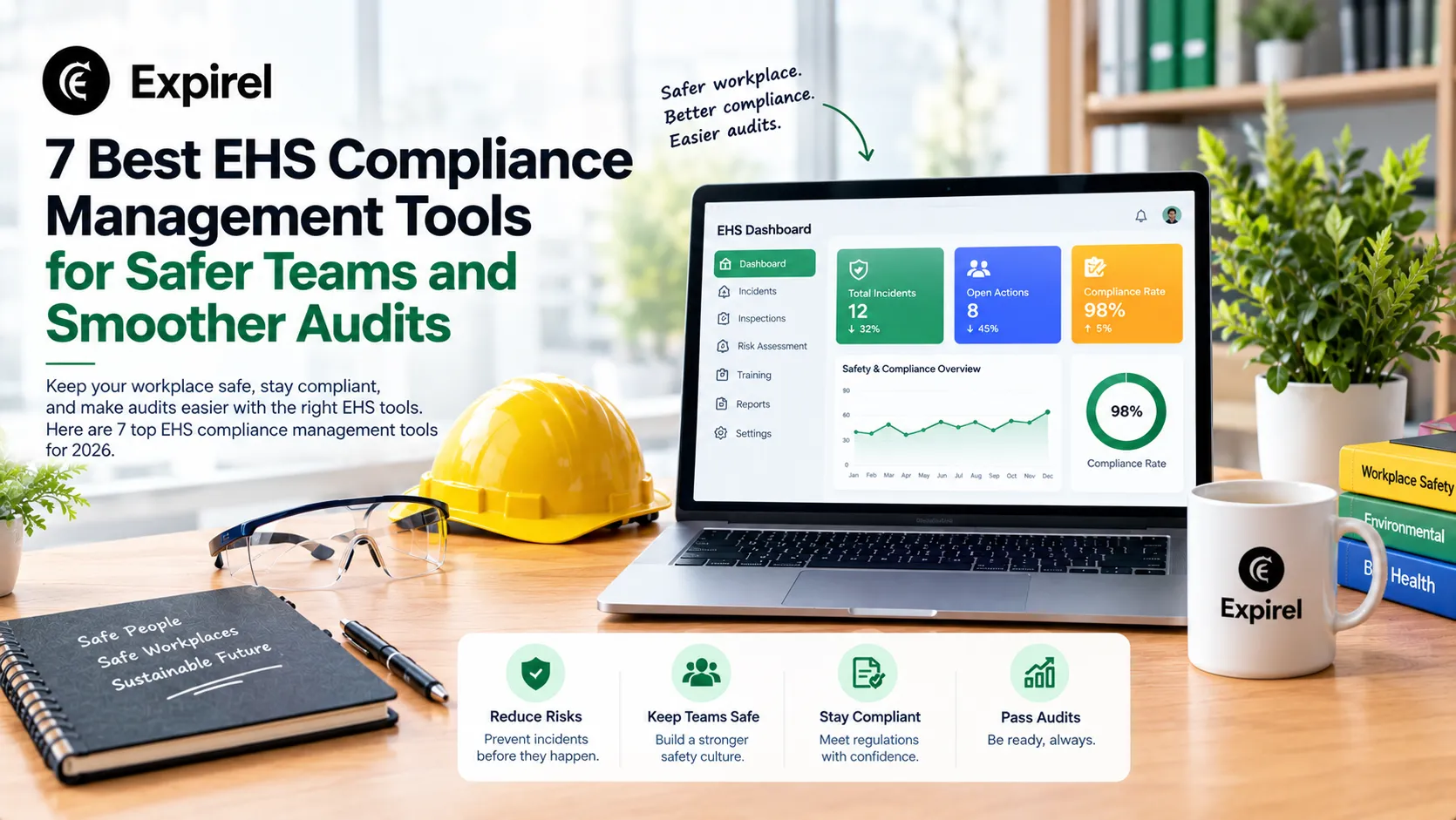
Picking safety software shouldn't feel like searching for a needle in a haystack, but with dozens of vendors making nearly identical claims, it often does. The right platform centralizes training, inspections, and certification tracking in one place, and turns audit prep from a last-minute scramble into something that's already sitting ready in a dashboard.
The market is crowded specifically because the category is broad; some tools focus on frontline safety workflows, others on scalable compliance training, and a few try to do both. We reviewed seven platforms that consistently come up in this space and looked at what each one actually does well, where each one falls short, and who each one genuinely fits.
1. iTacit
iTacit is built specifically for frontline teams who don't have a company email address a detail that matters more than it sounds, since a lot of safety software quietly assumes every worker sits at a desk. It brings training, inspections, certifications, incident reporting, and corrective actions into one streamlined system accessible from a mobile device.
Digital safety forms JSAs, tailboards, inspections, near-miss and incident reports work offline, so a dropped signal in a remote site or a warehouse basement doesn't stall the paperwork. Workers can still capture photos, signatures, and field notes without connectivity, with everything syncing once a connection returns.
Automated workflows track certification schedules and flag reminders before deadlines hit, giving safety teams a live view of what's current, what's coming due, and what's already overdue across every location at once. SOP and policy control keeps a single current version of every procedure live, while logging who's read it and preserving version history underneath. Audit-ready dashboards pull training logs, policy sign-offs, corrective actions, and expiry data into one clean view rather than several disconnected spreadsheets.
Best for: dispersed frontline teams in trucking, manufacturing, energy, utilities, and construction especially organizations managing several locations that need standardized processes and live visibility into where compliance gaps actually sit.
2. ProProfs Training Maker
ProProfs Training Maker leans on AI to remove the slowest part of compliance training: building the course itself. Describe a topic, and the platform generates an outline, quizzes, and surveys automatically, turning what typically takes days into something closer to minutes.
The platform ships with 200+ ready-made courses covering workplace safety, OSHA training, HIPAA, FDA regulations, and hazmat awareness, each including video, quizzes, and assessment. These work as-is or can be rebuilt with your own branding and materials: PowerPoint decks, videos, PDFs, and documents all upload directly into a course. The quiz builder covers 15+ question formats with access to a bank of over a million pre-built questions, including multiple choice, fill-in-the-blank, and video-response formats.
Mobile learning runs across phones, tablets, and desktops, with content available in English, Spanish, and 70+ other languages a genuine advantage for a multilingual workforce. Single sign-on authenticates automatically through Google or social credentials, and reporting exports to Excel, PDF, or CSV, filterable by timeframe.
Best for: organizations needing to deploy training quickly across dispersed teams, particularly where OSHA compliance and safety certification are the core requirement rather than a side feature.
3. Schoox
Schoox takes a different angle than most compliance platforms: it connects training directly to measurable business outcomes- retention and operational efficiency rather than treating compliance as a tracking exercise on its own.
AI identifies skill gaps and builds targeted training automatically. Any course can be marked compliance-relevant at creation or afterward, with completion tracked organization-wide a worker with an active certificate or a completed course shows as compliant in real time on the dashboard. Automated enrollment removes manual assignment entirely: set the rule once, and the system handles who gets what training, including recurring annual recertification without anyone chasing a missed deadline.
A content marketplace of 18,000+ on-demand courses across 65 topic areas, with partnerships feeding continuously updated compliance material, adds real depth for organizations that don't want to build every course themselves. Blended learning packages combine online material with in-person demonstrations evaluated by certified operators, and the platform scales into complex franchise and multi-location structures with granular permission controls.
Best for: distributed workforces and franchise operations that need training tied to operational outcomes, not just a completion checkbox.
4. CYPHER Learning
CYPHER Learning targets enterprise-scale deployments for organizations managing 500+ learners monthly with AI automation aimed at cutting course-creation time dramatically. CYPHER Agent can generate a full course from an existing policy manual or site guide in roughly ten minutes, reaching 80–90% content completion automatically before a human ever reviews it.
Automated enrollment assigns training by role, department, or location without manual setup, and recertification runs on predefined renewal rules the system enforces on its own. Digital certificates issue automatically on completion, with expiration tracking and automated re-enrollment built directly into the workflow one of the more complete certification-lifecycle setups in this list. A Learning Meter tracks actual time spent in training and feeds that data back into payroll systems, which matters for organizations that need precise records for both compliance and compensation.
Integration with Workday, SAP, and Oracle keeps compliance data connected to existing enterprise systems rather than living in a silo, and the platform reports administrative workload reductions of up to 50% through this level of automation.
Best for: mid-size to enterprise organizations, particularly in healthcare and technology, needing rapid onboarding and deep systems integration alongside compliance tracking.
5. BrainCert
BrainCert combines course creation and live virtual classrooms in a single dashboard, with security credentials including SOC 2 Type II, ISO 27001:2013, HIPAA, and GDPR that matter specifically to organizations in regulated industries evaluating where sensitive compliance data actually lives.
The platform's AI course creator can build entire compliance modules when a regulation changes, and updating a lesson once pushes that change to every course using it, removing the manual work of chasing down multiple outdated versions across departments. Automated assignment handles mandatory training for individuals, teams, or full departments, and certification management produces digital certificates suited to healthcare, aviation, and finance, where licensing requirements are strict.
Live virtual classroom tools whiteboards, breakout rooms, hand-raise, live quizzes support instructor-led compliance sessions, while microlearning and drip-content delivery handle the self-paced side. Role-based access keeps sensitive compliance material restricted to authorized staff only.
Best for: healthcare, construction, and other multi-regulation industries needing both live instruction and self-paced training under one security-certified platform.
6. Blackboard (formerly the Anthology Teaching & Learning platform)
A note worth reading before this one: this platform's ownership changed significantly and recently. Anthology, formed by a 2021 merger with Blackboard, filed for Chapter 11 bankruptcy in September 2025 after accumulating substantial debt tied to that merger. As part of the restructuring, Anthology's separate business units were sold off, and the core learning platform — the part relevant to EHS training — emerged from bankruptcy in February 2026 as a standalone, debt-free company operating under the Blackboard Inc. brand, under new ownership. If you're evaluating this platform, confirm current contract terms and support structure directly, since a lot changed in the last year.
The platform itself, Blackboard Learn, remains a serious option for organizations with strict security requirements it maintains FedRAMP and StateRAMP certification for government clients and GDPR compliance for global privacy needs, and continues to serve organizations including OSHA, MetroHealth System, and the Wyoming Law Enforcement Academy. OSHA specifically adopted it to replace fragmented training delivery, gaining the ability to run webinars, archive materials, meet federal security standards, and implement paperless recordkeeping.
Training runs through self-paced courses and instructor-led sessions, with course management and virtual classroom tools available across desktop and mobile. AI features support learning outcomes, and an open architecture allows integration flexibility for organizations with existing systems already in place.
Best for: government agencies, healthcare systems, and law enforcement organizations that specifically require federal security certification but confirm the platform's post-restructuring support and roadmap before committing to a long-term contract.
7. Coassemble
Coassemble solves a different problem than the rest of this list: turning documentation you already have into structured training, rather than building courses from scratch. Its AI scans existing PDFs, PowerPoints, and policy manuals and reshapes them into interactive courses with lessons and quizzes ready for review work that typically takes weeks of design time condensed into minutes.
Updating source content and pushing the change to every employee happens without the usual scramble when a regulation shifts. SOC2 certification covers the security side, and the platform integrates directly into Slack, so training lives where teams already work rather than in a separate portal nobody opens voluntarily. SCORM export connects to any existing LMS without a rebuild, and completion, audit trail, and time-on-course tracking keep oversight straightforward.
Best for: organizations with substantial existing documentation, particularly healthcare and finance that need frequent compliance updates without redesigning training from zero every time a rule changes.
Why Certification Expiration Tracking Matters Most in EHS Compliance Software
Two platforms in this list, iTacit and CYPHER Learning, highlight a feature worth pulling out on its own: automated tracking of when a certification is about to expire, with a reminder that fires before it does rather than after. This sounds like a minor convenience until you consider what actually happens without it: a certified operator's license lapses quietly, nobody notices until an audit or, worse, an incident, and the gap between "certified last year" and "certified right now" turns into the exact finding an inspector is trained to look for.
This is the same underlying problem Expirel is built to solve, just in a different setting, tracking a date that matters before it quietly becomes a problem, rather than discovering the lapse after the fact. Whether it's a workplace certification, a subscription, or a household item with a use-by date, the mechanism that actually prevents the failure is the same: a system that surfaces the deadline on its own, instead of relying on someone remembering to check. If your organization's compliance software doesn't handle this natively, treating certification renewal as its own tracked routine on a calendar, in a spreadsheet, or in a dedicated expiry-tracking tool closes a gap that's otherwise easy to miss until it's already cost you an audit finding.
How to Actually Choose Between These Seven
Work through these questions before comparing feature lists line by line:
Do your workers have company email addresses? If a meaningful share of your workforce doesn't, iTacit's mobile-first, offline-capable design solves a real access problem most platforms assume away.
Are you building training from scratch, or do you already have documentation? Coassemble is built specifically for the second case, reshaping existing PDFs and manuals rather than starting over.
How many learners, and how fast do you need to deploy? ProProfs and CYPHER Learning both emphasize rapid course generation, but CYPHER is built for enterprise scale (500+ learners) while ProProfs suits faster, smaller deployments.
Do you need government-grade security certification specifically? Blackboard's FedRAMP and StateRAMP certification matters if you're in government, healthcare, or law enforcement, but weigh the recent ownership change into that decision.
Does your training need to connect to business outcomes, not just completion rates? Schoox is built specifically around that connection, which matters if leadership wants to see training tied to retention or efficiency metrics.
Do you need live, instructor-led sessions alongside self-paced content? BrainCert's virtual classroom tools are more built-out here than most alternatives on this list.
Mistakes Organizations Make Choosing EHS Software
Assuming every platform assumes desk-based access. A frontline workforce without company email needs software built around that constraint from the start, not a desktop tool retrofitted with a mobile app.
Choosing based on AI course-generation speed alone. Fast course creation matters less than whether the generated content actually meets your specific regulatory requirements; always review before deploying at scale.
Treating certification expiration as something the LMS will always catch. Confirm specifically whether expiration tracking is automated or something an admin has to check manually; the two platforms in this list that automate it (iTacit, CYPHER) treat it very differently from ones that don't mention it as a distinct feature.
Not checking a vendor's financial and ownership stability. Anthology's 2025 bankruptcy is a real example of why this matters: a platform's feature set doesn't help if the company behind it is mid-restructuring when your contract renews.
Picking enterprise-scale software for a small team, or the reverse. CYPHER Learning's strength is 500+ learner deployments; forcing it onto a 30-person team means paying for scale you don't need, much like a lightweight tool strains when you're managing multiple regulated sites.
The Bottom Line
None of these seven platforms are interchangeable, despite how similar their marketing pages can look. iTacit fits dispersed frontline teams without email access. Coassemble fits organizations sitting on documentation they haven't structured yet. CYPHER and Schoox fit enterprise scale with different priorities: automation depth versus business-outcome tracking. BrainCert fits regulated industries needing live instruction alongside self-paced content. Blackboard fits organizations needing federal-grade security certification, with the caveat that its ownership just changed and that's worth confirming directly. Match the platform to the actual shape of your workforce and compliance requirements first, and treat certification expiration tracking as a question to ask explicitly rather than an assumption to make about any of them.
Frequently Asked Questions
Q: What's the difference between EHS compliance software and a general LMS?
A general learning management system delivers and tracks training content. EHS compliance software adds the safety-specific layer on top: certification expiration tracking, incident reporting, inspection forms, audit-ready dashboards, and regulatory-specific course libraries (OSHA, HIPAA, hazmat). Several platforms in this list, like Blackboard, started as general LMS platforms and added compliance-specific features over time.
Q: Do these platforms work for frontline workers without a company email address?
iTacit is built specifically for this case, with a mobile-first design and offline capability for workers without desk access or company email. Most other platforms in this list assume some form of digital access, whether through a company account or personal device, so confirm this specifically if a large share of your workforce is frontline.
Q: How does automated certification expiration tracking actually work?
The system logs when a certification was issued and its validity period, then triggers a reminder to the employee and manager before the expiration date arrives, giving enough lead time to complete recertification without a coverage gap. iTacit and CYPHER Learning both build this in natively; on platforms that don't, it's worth confirming whether tracking is manual or automated before assuming it's covered.
Q: Is Anthology still a safe choice for EHS and compliance training?
The platform itself, now operating as Blackboard Inc. emerged from its 2025 Chapter 11 restructuring debt-free with new financing, and continues serving existing clients including OSHA. That said, any organization evaluating it should confirm current contract terms, support structure, and roadmap directly given the recent ownership change, rather than relying on older marketing material describing "Anthology" as the parent brand.
Q: Which of these platforms is best for a small business rather than an enterprise?
ProProfs Training Maker's forever-free plan (up to 10 learners) and Coassemble's unlimited free AI course creation both suit smaller teams well. CYPHER Learning and Schoox are built around enterprise scale and pricing that reflects it, making them a poor fit for a small team's budget and actual needs.

Fahad Ahmad
Founder of EXPIREL · Digital Entrepreneur · Product Management Specialist
Fahad Ahmad is the founder of EXPIREL and a digital entrepreneur with over 10 years of experience in SaaS development, SEO, and digital product creation. He focuses on building practical solutions that help individuals and businesses manage product expiration dates, organize inventory, track habits, and improve daily productivity.
Through EXPIREL, Fahad shares actionable guides, product management tips, barcode scanning tutorials, and research-backed insights designed to help users reduce waste, stay organized, and make smarter decisions.
Related Articles
View all
8 Best Salesforce Data Collection Tools for Healthcare Compliance
September 1, 2026
Compare 8 HIPAA-compliant Salesforce tools for healthcare data collection, from Health Cloud to FormAssembly. See BAA coverage, cost, and setup effort.
11 Best Social Media Productivity Tools to Save Time in 2026
October 12, 2026
Compare 11 social media productivity tools for 2026 that save time on routines, scheduling, design, automation, video, analytics, and link tracking.
Best Productivity Apps for Medical Students in 2026: Pick by Stage
October 9, 2026
Find the best productivity apps for medical students in 2026: free picks, a stack for each stage, tools for doctors, and how to protect patient privacy.