Best Exercises for Personal Growth: 25 Daily Practices That Actually Improve Your Life
25 best exercises for personal growth, backed by a simple daily system. Build better habits for personal growth with steps you can start in minutes.
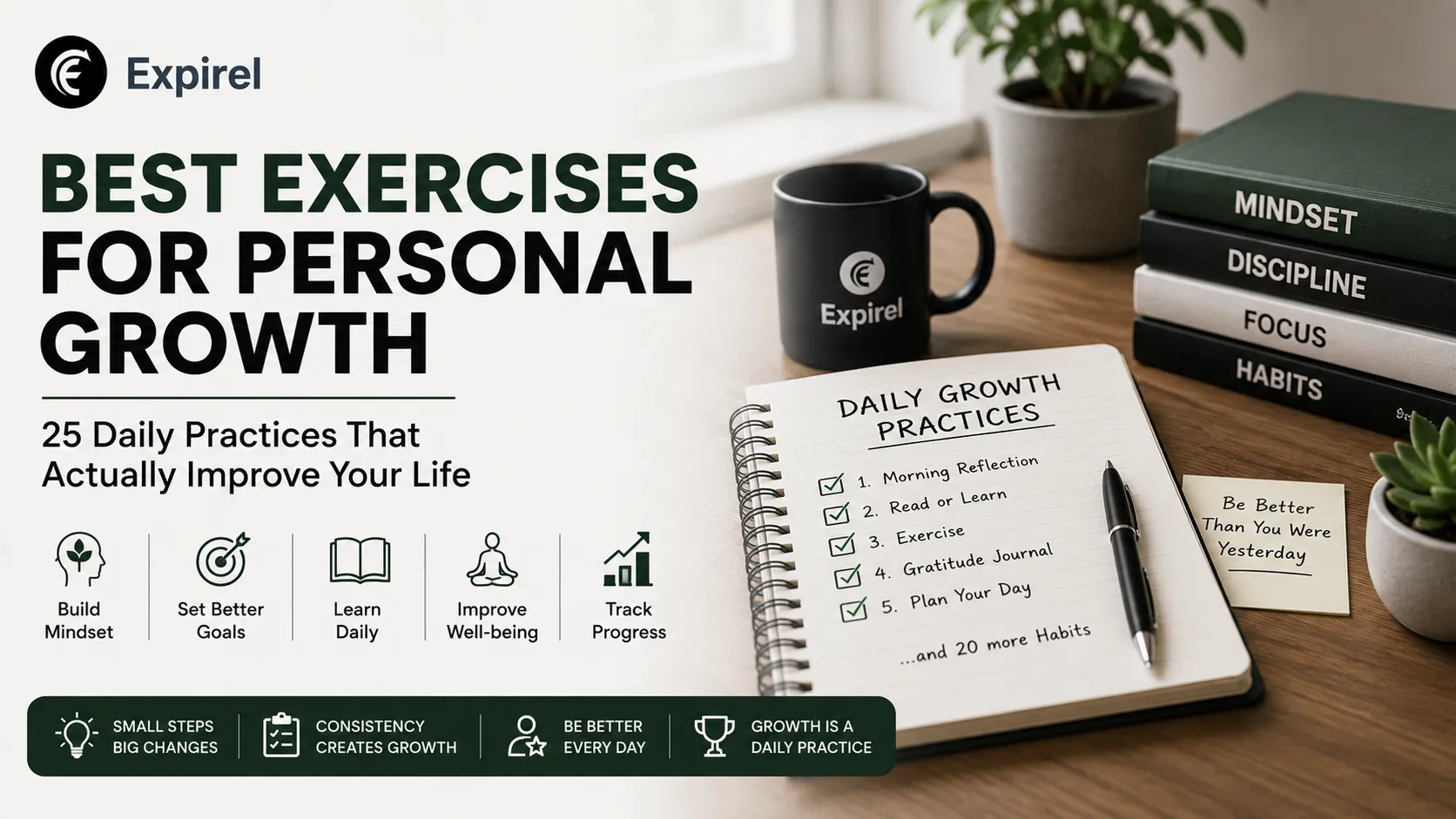
If you have searched for the best exercises for personal growth, you have probably already read ten articles that list the same five things: journaling, meditation, gratitude, reading, and "step out of your comfort zone." Useful advice, but vague. None of it tells you how often to do it, how to measure if it is working, or what to do when you skip three days in a row and feel like quitting.
This guide is different. It breaks personal growth into five working categories, gives you 25 specific exercises with a clear reason and a clear method for each, and ends with a system for actually sticking to them. This is not theory copied from a psychology textbook. It is a practical, experience-based framework you can start using today.
The best exercises for personal growth are short, repeatable daily actions across five areas: mindset and self-awareness, emotional regulation, discipline and habit-building, relationships, and purpose. Examples include a 3-line morning journal, box breathing, habit stacking, active listening drills, and a weekly review. The exercises work because they are specific, scheduled, and tracked, not because they are intense or time-consuming. Most people see early shifts within 2 to 3 weeks of consistent daily practice.
What Personal Growth Exercises Actually Mean
A personal growth exercise is not a one-time inspirational act. It is a repeatable action, done on a schedule, that changes how you think, feel, or behave over weeks and months. The word "exercise" matters here the same way it matters in the gym: one session barely moves the needle, but a consistent practice compounds.
Most self improvement exercises fail not because the exercise is wrong, but because people treat them as a one-off task instead of a habit with a measurable cadence. That is the gap this article closes.
Why Most Personal Growth Routines Fail
Too many exercises at once: Starting journaling, meditation, cold showers, and a new diet on the same Monday burns motivation fast. Pick one or two daily personal growth exercises and build from there.
No tracking system: If you cannot see your streak, you cannot see your progress, and you quit the moment life gets busy. This is the single biggest reason people abandon personal development activities within two weeks.
Vague exercises with no metric: "Read more" is not an exercise. "Read 10 pages before 9 a.m." is. Specificity is what separates an exercise from a wish.
5 Categories of Growth Exercises
To cover personal growth properly, you need exercises across five areas of life, not just one. Below is the map this article follows, with five exercises in each category for a total of 25.
Mindset and Self-Awareness Exercises
Emotional Regulation Exercises
Discipline and Habit-Building Exercises
Relationship and Communication Exercises
Purpose and Productivity Exercises
1: Mindset and Self-Awareness Exercises
1. The 3-Line Morning Journal
Why it works: Long journaling sessions get skipped because they feel like homework. Three lines is low friction, so it actually gets done.
How to do it: Each morning write: one thing you are grateful for, one thing you are anxious about, and one intention for the day. Takes under two minutes.
2. Thought Labeling
Why it works: Naming a thought ("that is anxiety talking") creates distance between you and the thought, which reduces its power over your decisions.
How to do it: Whenever a strong reaction hits, pause and silently label it: judgment, fear, comparison, ego. Just naming it is the exercise.
3. Weekly Self-Audit
Why it works: You cannot improve what you do not review. A weekly check-in catches drift before it becomes a bad month.
How to do it: Every Sunday, answer three questions in a notebook: What worked this week? What drained me? What is one change for next week?
4. Values Ranking Exercise
Why it works: Most people have never actually ranked their own values, so they make decisions on autopilot or other people's priorities.
How to do it: List 10 personal values (health, freedom, family, money, status, creativity, etc.) and force-rank them top to bottom once a month. Watch how the order shifts as your life changes.
5. The Outsider Question
Why it works: Self-awareness is limited by self-bias. Asking how a neutral observer would see your week pulls you out of your own head.
How to do it: Once a week, write one paragraph describing your recent behavior as if a stranger were observing you. Be specific, not kind or harsh.
Key takeaway: Self-awareness exercises work best in short daily doses, not long occasional sessions. Three lines a day beats a 2-hour journaling session once a month.
2: Emotional Regulation Exercises
6. The 90-Second Rule
Why it works: Neuroscience research popularized by Dr. Jill Bolte Taylor suggests an emotional surge lasts about 90 seconds in the body before it is the story we keep telling that extends it.
How to do it: When a strong emotion hits, set a mental or phone timer for 90 seconds. Breathe and notice the sensation without acting on it or narrating it. Decide what to do only after the timer ends.
7. Box Breathing
Why it works: Slow, even breathing activates the parasympathetic nervous system and lowers physical stress signals within minutes.
How to do it: Inhale for 4 seconds, hold for 4, exhale for 4, hold for 4. Repeat for 4 rounds before any high-stakes conversation or decision.
8. Reaction Delay Practice
Why it works: Most regret comes from reacting in the heat of the moment. A short delay restores your ability to choose.
How to do it: Before responding to anything that triggers anger (an email, a comment, a text), wait at least 10 minutes before typing your reply.
9. Emotional Vocabulary Expansion
Why it works: People who can name their emotions precisely (frustrated vs. disappointed vs. embarrassed) regulate them better than people who only say "bad" or "fine."
How to do it: Keep a list of 20 emotion words on your phone. Once a day, pick the most accurate word for how you feel instead of a generic one.
10. The Letter You Never Send
Why it works: Writing out resentment or hurt gives it an outlet without damaging a relationship through an impulsive confrontation.
How to do it: When you are upset with someone, write them a full, honest letter. Then do not send it. Reread it the next day and decide what, if anything, is worth saying calmly.
Key takeaway: Emotional regulation is not about suppressing feelings. It is about adding a small delay between feeling and reacting.
3: Discipline and Habit-Building Exercises
11. The Two-Minute Start Rule
Why it works: The hardest part of any habit is starting. Shrinking the entry point removes the excuse of "I do not have time."
How to do it: Commit to just two minutes of the habit (two minutes of reading, two push-ups, two minutes of planning). Most days you will naturally continue past two minutes.
12. Habit Stacking
Why it works: Attaching a new habit to an existing one borrows the existing habit's automatic trigger, so you do not have to rely on willpower or memory.
How to do it: Pick a habit you already do daily without thinking, like brewing coffee, and attach a new habit right after it: coffee, then journal three lines.
13. The Streak Visual
Why it works: Seeing a visible chain of consistency creates a psychological cost to breaking it, often called "don't break the chain."
How to do it: Mark every day you complete your chosen exercise on a calendar or app. The goal is simply not to break the visible streak.
14. Pre-Commitment Scheduling
Why it works: Habits done "whenever I have time" rarely survive a busy week. A fixed time slot removes the daily decision.
How to do it: Block a specific time on your calendar for your growth exercise, the same way you would block a meeting. Treat it as non-negotiable.
15. The Minimum Viable Day
Why it works: On bad days, all-or-nothing thinking causes people to skip entirely. A minimum version keeps the habit alive without burnout.
How to do it: Define the smallest version of each habit that still counts (one page instead of a chapter, one push-up instead of twenty) and use it on your worst days instead of skipping.
Key takeaway: Discipline is built through small, visible wins, not motivation. A streak you can see beats a goal you only think about.
4: Relationship and Communication Exercises
16. The Daily Appreciation Message
Why it works: Relationships grow through small, repeated deposits of attention, not occasional grand gestures.
How to do it: Send one specific, genuine message of appreciation to someone in your life every day, rotating between family, friends, and colleagues.
17. Active Listening Drill
Why it works: Most people listen to respond, not to understand. This exercise forces real listening.
How to do it: In your next three conversations, do not speak until you can summarize what the other person said in your own words and they confirm you got it right.
18. The Difficult Conversation Rehearsal
Why it works: Avoidance of hard conversations is often fear of saying it badly, not fear of the topic itself.
How to do it: Before a difficult conversation, write down the three key points you want to say in plain, calm language, then read them aloud once before the actual talk.
19. Weekly Check-In With a Close Person
Why it works: Many relationships drift not from conflict but from silence. A scheduled check-in prevents distance from building unnoticed.
How to do it: Set a 15-minute weekly call or conversation with one important person where you ask: how are you really doing, and is there anything I should know?
20. The Apology Without Excuses
Why it works: An apology followed by "but" cancels itself out. Practicing a clean apology builds trust faster than almost any other habit.
How to do it: The next time you are wrong, say exactly what you did, acknowledge the impact, and stop. No explanation, no defense, no "but."
Key takeaway: Relationships grow through small, repeated deposits of attention and honesty, not occasional grand gestures.
5: Purpose and Productivity Exercises
21. The One Big Thing Rule
Why it works: Long to-do lists create motion without progress. Naming one priority forces real focus.
How to do it: Before starting work each day, write down the single most important task. Do it before checking messages or email. If browser distractions make this difficult, productivity extensions can help you protect that focused work period. See our guide to the best productivity Chrome extensions for tools that can block distracting websites, reduce tab overload, and create a more focused browsing environment.
22. The Energy Audit
Why it works: Time management fails when energy is ignored. Matching tasks to your natural energy curve gets more done with less effort.
How to do it: For one week, note your energy level (high, medium, low) every two hours. Then schedule demanding tasks during your recorded high-energy windows.
23. Future Self Letter
Why it works: Vague goals fade. A concrete picture of your future self gives daily exercises a reason beyond willpower.
How to do it: Once a month, write a one-page letter from your one-year-from-now self describing what daily habits got them there.
24. The Weekly Review and Reset
Why it works: Without a reset, unfinished tasks and mental clutter pile up and quietly drain motivation.
How to do it: Every Friday or Sunday, clear your task list, file away what is done, and plan the three priorities for next week before you stop working.
25. Skill Stacking Practice
Why it works: Combining two moderate skills often creates more career and personal value than mastering one skill to an elite level.
How to do it: Spend 20 minutes, three times a week, on a skill that complements something you already do well, rather than starting from zero in an unrelated area.
Key takeaway: Purpose and productivity tips and exercises work together: a clear daily priority and a known energy pattern remove most of the friction from getting things done.
How to Build a Routine That Actually Sticks
Picking exercises from the list above is the easy part. Most people fail at the next step: building them into a routine that survives a bad week. Use this framework.
Choose 2, not 10: Pick one exercise from two categories that match your current weak point. Trying all 25 at once guarantees burnout within a week.
Anchor each exercise to an existing routine: Attach it to something you already do daily, like brushing your teeth or making coffee, using the habit stacking method above.
Set a visible tracker: Use a wall calendar, a notes app, or a dedicated habit tracker. The exercise must be marked the moment it is done, not from memory at night.
Review weekly, not daily: Daily self-judgment causes guilt spirals. A weekly review keeps you honest without becoming punishing.
Add the next exercise only after 21 consistent days: Layering a new habit on a shaky foundation is the most common reason people quit everything at once.
How to Track These Exercises Without Losing Momentum
The exercises above only work if you can see whether you are actually doing them. Memory is unreliable, and a paper calendar gets forgotten or lost within a month for most people. This is exactly the gap a dedicated system fills.
Expirel Habit Tracker is built for exactly this kind of routine: short, repeatable, daily personal growth exercises that need a visible streak and a simple weekly review, rather than a complicated project management tool. You can log each of the 25 exercises above as a separate habit, watch your streak grow, and see at a glance which category (mindset, emotional regulation, discipline, relationships, or purpose) is being neglected in a given week. If consistency has been your biggest obstacle, pairing this list with Expirel's Habit Tracker removes the guesswork of remembering what to do and whether you actually did it.
Common Mistakes People Make With Personal Growth Exercises
Treating motivation as required: Waiting to "feel ready" before starting an exercise means most days never happen. Systems work without motivation; motivation is unreliable.
Comparing your Day 5 to someone else's Day 500: Personal development activities compound. A habit that looks unimpressive at two weeks often looks transformative at six months.
Quitting after one missed day: One missed day is a data point, not a failure. Two missed days in a row is the real danger zone worth addressing immediately.
Choosing exercises that do not match your actual gap: Doing five mindset exercises while your real problem is poor sleep or constant conflict at home wastes effort. Match the category to the real issue. Growth exercises cannot outpace a habit that is actively working against you. If you suspect that is the case, see our breakdown of the everyday habits that damage your health over time before layering on new practices.
Tracking too many metrics: Tracking 10 habits with no clear priority creates noise. Track the 2 to 3 exercises that matter most right now.
Conclusion
The best exercises for personal growth are not secret or complicated. They are small, specific, and repeated long enough to compound. The five categories above mindset, emotional regulation, discipline, relationships, and purpose cover the areas that actually shape a life. Pick two exercises today, anchor them to something you already do, track them visibly, and review weekly. That is the entire system. Everything else is detail.
Frequently Asked Questions
Q: What are the best exercises for personal growth?
The best exercises for personal growth are short, repeatable daily actions across five areas: mindset and self-awareness, emotional regulation, discipline, relationships, and purpose. Strong starting examples are a 3-line morning journal, box breathing, habit stacking, an active listening drill, and a weekly review. They work because they are specific and scheduled, not because they take a lot of time.
Q: What are simple daily personal growth exercises for beginners?
Beginners should start with the 3-Line Morning Journal and the Two-Minute Start Rule. Both take under five minutes combined, require no equipment, and build the habit of consistency before adding harder exercises like emotional regulation or relationship work.
Q: What is the difference between personal growth exercises and self improvement exercises?
Personal growth exercises are specific, repeatable, measurable actions, such as writing three lines or breathing for four counts on each side. Self improvement exercises are a broader term that can also include one-time events like a workshop or a single coaching session. The exercises in this guide are the repeatable building blocks behind lasting self improvement.
Q: How long until daily personal growth exercises show results?
Most people notice small shifts in mood, focus, and clarity within 2 to 3 weeks of consistent daily practice. Visible changes in habits and relationships usually appear after 2 to 3 months. Discipline-focused exercises tend to show the fastest feedback because of the visible streak effect.
Q: What are the best personal development activities for someone with no time?
If time is the biggest constraint, use the Two-Minute Start Rule combined with habit stacking. Attach a two-minute version of one exercise to something you already do daily, like brewing coffee, so it requires no extra time slot and no extra memory.
Q: Which personal growth exercises should I do every single day?
The exercises with the highest daily value are the 3-Line Morning Journal, the One Big Thing Rule, and box breathing. These three cover self-awareness, focus, and emotional regulation in under 10 minutes combined, forming a strong daily baseline before adding weekly exercises like the self-audit or relationship check-in.
Q: What habits for personal growth actually stick long term?
Habits stick when they are anchored to an existing routine, tracked visibly, and reviewed weekly rather than daily. Habits that rely solely on motivation, with no fixed time slot and no tracking, are the most likely to be abandoned within the first month.
Q: Can personal growth exercises replace therapy or coaching?
No. These are practical daily exercises for general growth, not a substitute for professional support if you are dealing with a clinical mental health condition. Use them alongside professional help, not instead of it, if you are currently working with a therapist or coach.
Q: How do I know which category of exercise I need most?
Match the category to your actual problem rather than the category that sounds appealing. Frequent conflict points to relationship exercises, low follow-through points to discipline exercises, constant overwhelm points to emotional regulation exercises, and a lack of direction points to purpose and productivity exercises.

Fahad Ahmad
Founder of EXPIREL · Digital Entrepreneur · Product Management Specialist
Fahad Ahmad is the founder of EXPIREL and a digital entrepreneur with over 10 years of experience in SaaS development, SEO, and digital product creation. He focuses on building practical solutions that help individuals and businesses manage product expiration dates, organize inventory, track habits, and improve daily productivity.
Through EXPIREL, Fahad shares actionable guides, product management tips, barcode scanning tutorials, and research-backed insights designed to help users reduce waste, stay organized, and make smarter decisions.
Related Articles
View all
Personal Growth Habits: The Honest Guide to Building a Life That Actually Improves
July 2, 2026
Discover 25 powerful personal growth habits that improve mindset, discipline, relationships, and purpose. Build a better life one day at a time.
Personal Growth Quotes That Actually Change How You Think Not Just How You Feel
July 9, 2026
From Marcus Aurelius to John Maxwell, personal growth quotes that actually work, each paired with a specific action so you use them, not just save them.

Best Productivity Chrome Extensions in 2026: The Only List That Tells You How to Actually Use Them
September 8, 2026
13 Best productivity Chrome extensions in 2026 with setup tips, privacy ratings, Cold Turkey vs StayFocusd, Google extensions, and persona-based picks.