Personal Growth Habits: The Honest Guide to Building a Life That Actually Improves
Discover 25 powerful personal growth habits that improve mindset, discipline, relationships, and purpose. Build a better life one day at a time.
Personal growth habits are the daily, weekly, and monthly behaviors that compound into a meaningfully better version of you over time. Not the motivational kind of better. The measurable kind. Better relationships, sharper focus, calmer responses under pressure, more done with less wasted effort.
Most articles on personal development habits give you a list and call it a day. This guide goes further. It tells you what personal growth actually is (and what people get wrong about it), which habits build it at the fastest rate, how to measure whether your habits are working, and how to build a daily system that survives real life, not just a good week.
Every section below adds something the top-ranking articles on this topic leave out. Read it once, then use the checklists and frameworks to build your own practice.
Personal growth habits are specific, repeatable behaviors practiced daily or weekly across five areas: mindset, emotional regulation, discipline, relationships, and purpose. The best personal development habits are not complex. They are consistent. Examples include a 3-line morning journal, a weekly self-audit, habit stacking, an active listening drill, and a single daily priority. Most people see early results within 2 to 3 weeks when habits are tracked and anchored to existing routines.
What Is Personal Growth?
Personal growth is the ongoing process of becoming more self-aware, more capable, and more intentional in how you live. It covers how you think, how you handle emotion, how you treat people, and how well you follow through on what matters to you.
That is the clean definition. Here is the part most guides skip: personal growth is not the same as self-improvement, and confusing the two is why most people feel stuck.
Self-improvement tends to be outward and performance-focused: earn more, lose weight, read more books, get promoted.
Personal growth is inward and identity-focused: respond better under pressure, recognize your own patterns, build deeper relationships, act in line with your actual values.
One is about output. The other is about who is doing the outputting.
Personal growth examples from real life: catching yourself about to react defensively and choosing curiosity instead. Noticing you have been avoiding a difficult conversation for three weeks. Realizing your actual priority and your calendar do not match. These moments are personal growth in action, not achievements you post online.
Key takeaway: Personal growth is not a destination you reach. It is a rate of change you sustain. Your personal growth rate is not measured by what you have achieved but by how consistently you are improving across what matters to you.
Why Most Personal Development Habits Fail Within 30 Days
This is the honest part most habit guides avoid. The exercises do not fail. The system around them fails. Here are the four real reasons personal growth habits break down, based on patterns that repeat across almost every person who has tried and quit:
1. The habits are borrowed, not chosen
You read that journaling changed someone's life, so you start journaling. But if your actual gap is emotional reactivity, not self-awareness, journaling gives you no feedback and fades fast. Before picking a habit, identify which of the five growth areas is your real weak point right now. The right habit in the wrong area gives you the feeling of progress without the results.
2. There is no anchor point
Habits that live in a vague time slot, "sometime in the morning" or "whenever I have a minute," get displaced by everything else in life. An anchor ties a new habit to an existing automatic behavior, like making coffee, brushing your teeth, or sitting down at your desk. Without an anchor, the habit depends on daily decision-making, and daily decision-making is expensive and unreliable.
3. The feedback loop is invisible
When you work out, you eventually see or feel a change. Most personal growth habits produce invisible internal shifts that are hard to notice week to week. Without a tracking system, people assume the habit is not working and quit. The habit was working. The tracking was missing.
4. Too many habits started at once
Starting five new habits on the same Monday is not ambition. It is a setup for failure. Each new habit borrows willpower from a limited daily pool. Three weeks in, one missed day triggers guilt, guilt triggers quitting everything, and you are back to zero. One habit at a time, held for 21 days before adding another, is the correct sequence regardless of how motivated you feel at the start.
The 5 Categories of Personal Growth Habits
Sustainable personal growth requires habits across five areas, not just one. People who only focus on productivity habits and ignore emotional regulation habits hit a ceiling fast. People who only do mindset work and ignore discipline habits journal beautifully and follow through on almost nothing.
The five categories and their core function:
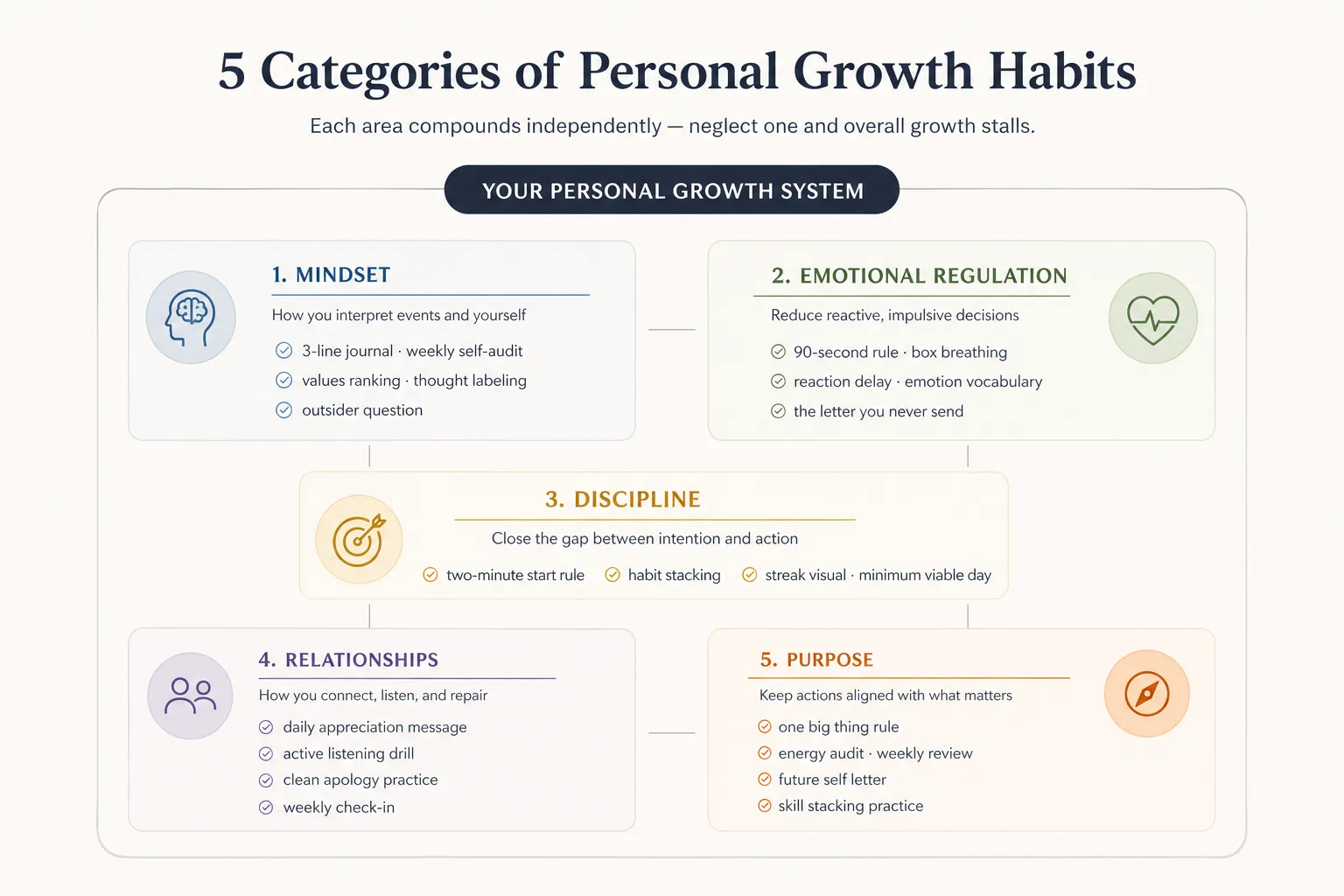
Mindset habits: Build self-awareness and shift how you interpret events and yourself.
Emotional regulation habits: Reduce reactive decision-making and improve your baseline emotional state.
Discipline habits: Close the gap between what you intend to do and what you actually do.
Relationship habits: Improve how you communicate, listen, repair, and connect with people.
Purpose habits: Keep your daily actions aligned with what actually matters to you long term.
Most people are strong in one or two of these and operating on autopilot in the rest. The quick audit below will show you where to focus first.
Which Category Do You Need Most?
You often regret things you said or did in the heat of the moment → emotional regulation.
You know what you should do but consistently do not do it → discipline.
Your relationships feel surface-level or frequently conflicted → relationship habits.
You feel busy but not like you are moving forward → purpose habits.
You react to life rather than steering it → mindset habits.
Key takeaway: Pick the category that stings a little when you read it. That is your starting point.
Personal Growth Daily Habits: What to Do Every Single Day
Daily habits are the foundation. Weekly habits are the review layer. Monthly habits are the recalibration layer. Start with the daily tier before building out.
These are the six personal growth daily habits with the highest return per minute invested:
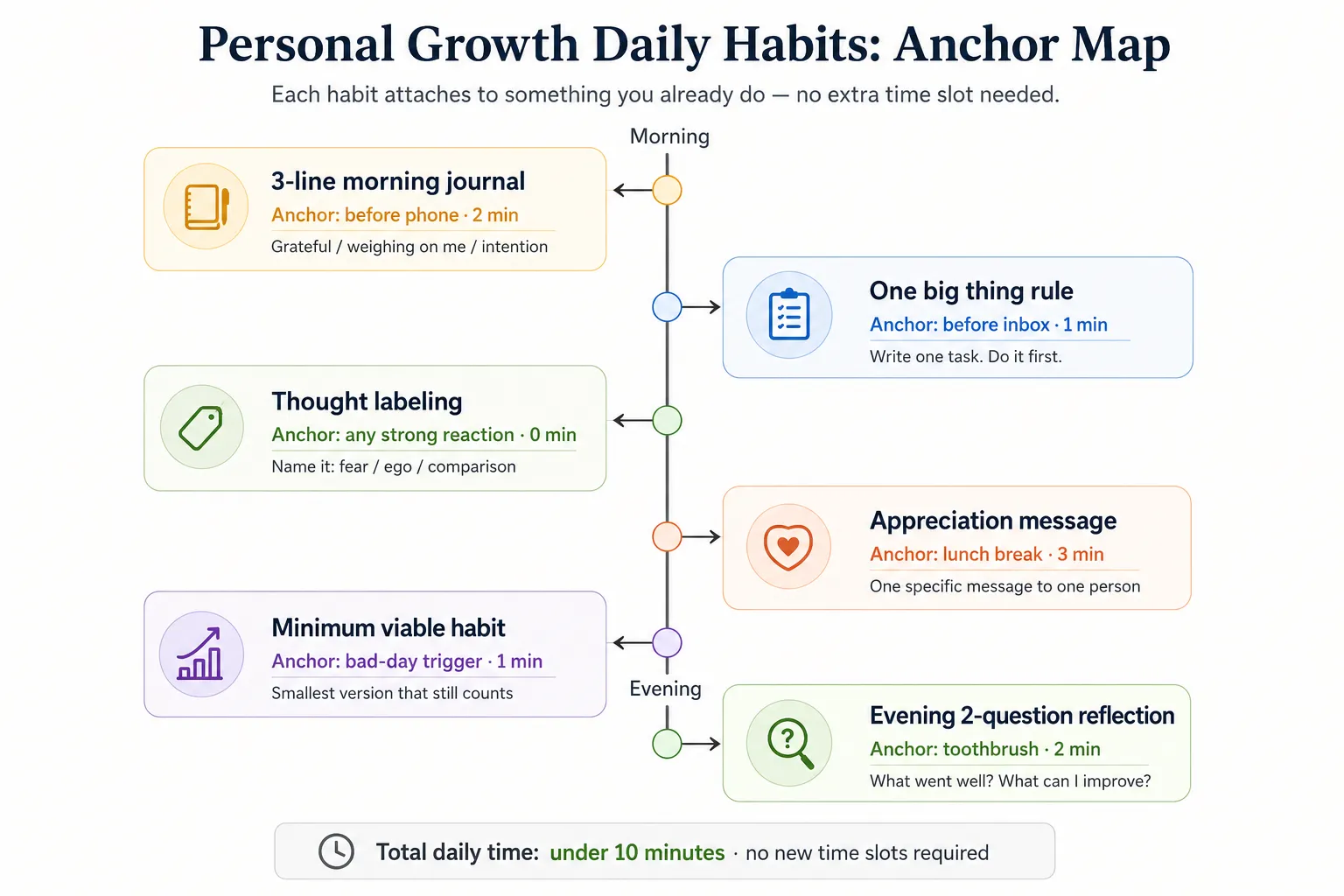
1. The 3-Line Morning Journal (2 minutes)
Write exactly three lines before your phone or inbox gets your attention: one thing you are grateful for, one thing that is weighing on you, and one clear intention for the day. This is not therapy or deep reflection. It is a daily reset that keeps your awareness sharp and your day pointed at something specific rather than reactive.
Why it beats a longer journal: a 10-minute journaling session requires energy and discipline. Three lines require neither. It gets done on hard days, travel days, and low-motivation days, which is when consistency actually matters.
2. The One Big Thing Rule (1 minute)
Before starting any work, write down the single most important task for the day. Not a to-do list. One item. Do it before opening email, messages, or social media. This habit is a combination of purpose and discipline: it forces daily alignment between what you intend to accomplish and what you actually spend your hours on.
3. Thought Labeling (throughout the day, zero extra time)
When a strong reaction hits irritation, comparison, defensiveness, worry pause for two seconds and name it silently: "that is fear," "that is ego," "that is comparison." Naming creates a small gap between the trigger and your response. That gap is where better decisions live. This habit requires no time block. It builds over days into a significantly calmer, more intentional response pattern.
4. A Single Appreciation Message (3 minutes)
Send one specific, genuine message of appreciation to one person in your life every day. Rotate between family, friends, and colleagues. Do not say "hey, thinking of you"; name a specific thing. "Your advice about the presentation last week helped more than I said at the time." Relationships grow through small, consistent deposits of attention. This habit costs almost nothing and has compounding returns on the quality of your closest relationships over months.
5. The Minimum Viable Habit on Bad Days
Define the smallest version of each of your core habits that still counts. One push-up instead of twenty. One sentence instead of three. One minute instead of ten. Use this version on your worst days instead of skipping entirely. A one-sentence journal entry keeps the habit alive. A skipped day, followed by another, breaks the chain. The chain matters more than the size of each link.
6. A 5-Minute Evening Wind-Down Reflection
Before sleep, answer two questions in your head or on paper: what went well today, and what is one thing I would handle differently? Not a full self-audit. Not a to-do list for tomorrow. Just two answers. This habit closes the feedback loop on each day and gradually trains you to notice patterns in your own behavior that longer weekly reviews can then act on.
Key takeaway: You do not need six new habits at once. Pick one from this list, anchor it to an existing daily routine, and hold it for 21 days before adding the next one.
Personal Development Habits Examples: Weekly and Monthly Tier
Daily habits build consistency. Weekly and monthly habits build direction. Here are the personal development habits examples that belong at each tier:
Weekly Habits
Weekly Self-Audit (Sunday, 10 minutes): Answer three questions in a notebook: what worked this week, what drained me, and what is one change for next week. This is not a performance review. It is a course-correction habit that catches drift before it becomes a bad month.
The Difficult Conversation Rehearsal: If there is a conversation you have been avoiding, spend five minutes writing the three key points you want to say in plain, calm language before having it. Avoidance usually comes from fear of saying it badly, not fear of the topic itself.
Energy Audit: Once a week for one month, note your energy level (high, medium, low) every two hours. After one month, you have a personal energy map. Schedule demanding tasks in your high-energy windows and low-effort tasks in your low-energy windows. This habit alone has a bigger impact on real productivity than most time-management systems.
Values Check-In: Once a week, pick one of your top values and ask: did my actions this week reflect this value? Not to feel guilty when the answer is no, but to notice the gap and close it.
Monthly Habits
Future Self Letter: Write one page from your one-year-from-now self, describing which habits got them there. Vague goals fade. A concrete picture of your future self gives your daily habits a reason that goes beyond willpower.
Values Ranking Exercise: List your top 10 personal values and force-rank them. Do this once a month and notice how the ranking shifts as your circumstances change. Most people have never done this even once, which means they make daily decisions on autopilot or on values they absorbed from other people, not their own.
Skill Stacking Session: Spend one hour on a skill that complements something you already do well. Combining two moderate skills creates more personal and professional value than grinding one skill to an elite level.
Personal Growth Behaviors vs Personal Growth Habits: The Real Difference
This distinction matters, and most guides blend the two into one vague category.
A personal growth behavior is a one-time or occasional action: attending a workshop, having a breakthrough conversation, reading a book that changes your thinking. Valuable. Not repeatable by design.
A personal growth habit is a scheduled, repeatable action that is designed to compound over time. It does not need a burst of motivation to happen. It has a fixed trigger, a consistent format, and a tracking mechanism.
Personal growth behaviors spark change. Personal growth habits sustain it. Most people experience periods of growth driven by behaviors (a life event, a hard conversation, a powerful book) without the habits underneath to hold the change in place. Six months later, they are back to the same patterns.
The goal of this guide is to give you the habits that make behaviors unnecessary for growth, because growth is already built into the structure of your days.
A behavior changes you once. A habit changes you every day.
How to Measure Your Personal Growth Rate
This is one of the most-searched and least-answered questions in the personal development space. People ask "what is personal growth" but what they really want to know is: how do I know if I am actually growing or just going through the motions?
Here is a practical framework for measuring personal growth rate across three time horizons:
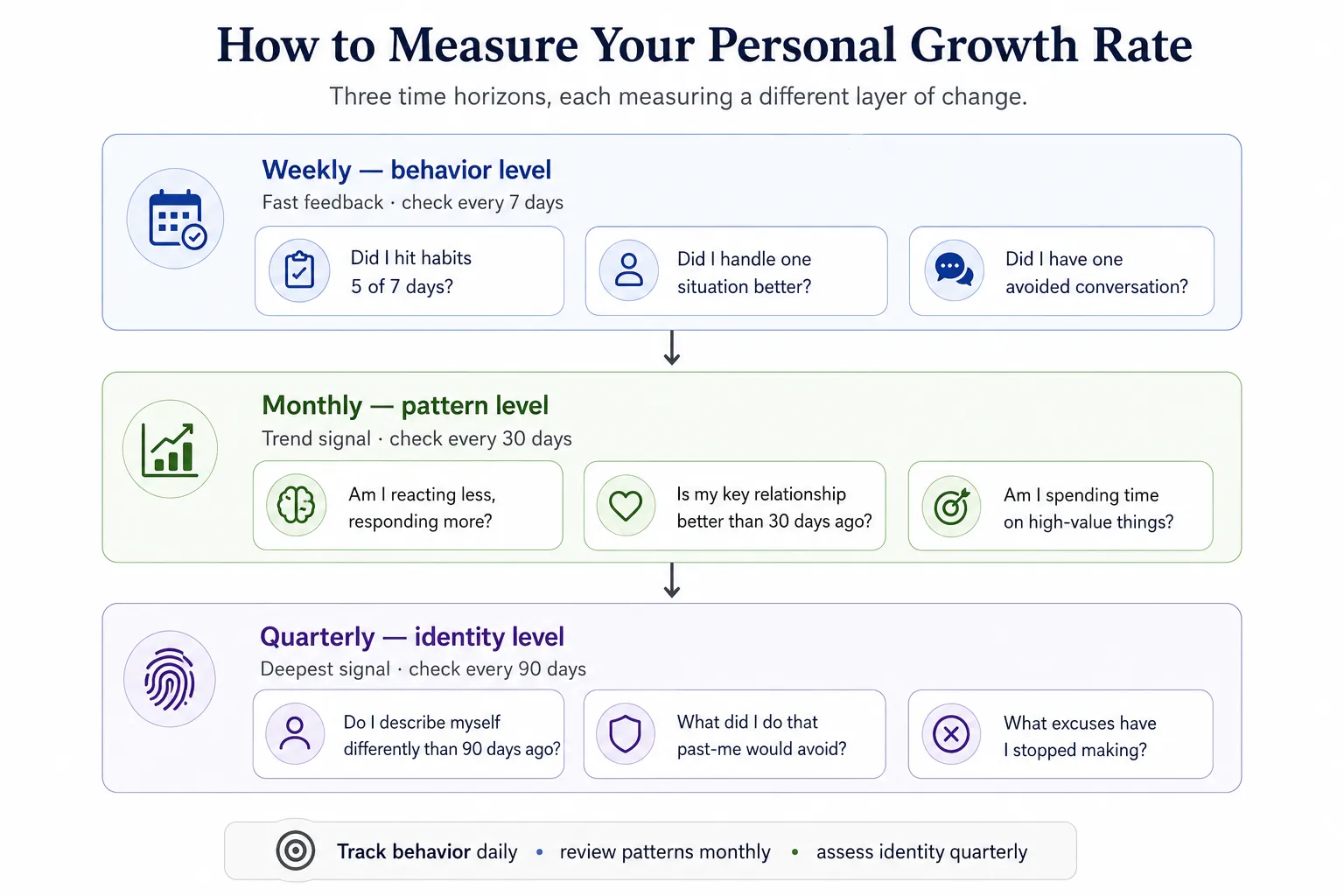
Weekly (Behavior Level)
Did I complete my daily habits at least 5 out of 7 days?
Did I handle one difficult situation better than I usually would?
Did I have one conversation this week I was previously avoiding?
Monthly (Pattern Level)
Am I reacting less and responding more in stressful situations?
Is my most important relationship in better shape than 30 days ago?
Am I spending more time on the things I ranked as high-value in my values audit?
Quarterly (Identity Level)
Do I describe myself differently than I did 90 days ago?
What have I done this quarter that my three-months-ago self would have avoided?
Where have I stopped making excuses I used to make regularly?
None of these are metrics you can put in a spreadsheet. But they are honest questions, and honest answers to them are the most reliable signal of real personal growth that exists.
Key takeaway: Track behaviors daily, review patterns monthly, and assess identity quarterly. Most people only do the last one, which means they wait 90 days to find out a habit was not working.
Step-by-Step System: Build Your Personal Growth Habit Stack
Here is the exact sequence to go from zero to a functioning personal growth habit system in four weeks without burning out or quitting:
Run the quick audit above and identify your highest-need category from the five areas.
Pick exactly one habit from that category from the daily habits list in this article.
Identify an existing anchor: something you already do every day without thinking, like brewing coffee, brushing your teeth, or sitting down at your desk. Attach the new habit immediately after.
Set up a visible tracker: a wall calendar, a notes app, or a dedicated habit tracker. Mark the habit the moment you complete it, not from memory at night.
Hold that single habit for 21 consecutive days before adding anything else. On your worst days, use the Minimum Viable Habit version.
At the 21-day mark, run a quick review: is the habit automatic? If yes, add one habit from a second category. If no, hold it for another week before layering.
Add the weekly self-audit to your Sunday routine after the first month. This is the layer that catches drift and keeps everything else on track.
Real-world example:
Sarah, a project manager, ran the quick audit and identified emotional regulation as her biggest gap. She picked thought labeling (zero extra time required) and anchored it to her commute. After 21 days, she added the evening wind-down reflection, anchored to brushing her teeth at night. At 60 days, she described herself as "less reactive at work," and her manager noticed the change before she mentioned it. Two habits. 60 days. No motivation required after week one.
How to Stay Consistent: Where Expirel Fits In
The system above works. The part that breaks it is the tracking layer, not because people forget the importance of tracking but because most tracking tools are either too complex or not designed for short personal habits.
Expirel Habit Tracker is built specifically for this kind of practice: short, repeatable daily personal growth habits that need a visible streak and a simple weekly view, not a project management dashboard. You can log each habit from this article, set your anchor time as a reminder, see your weekly pattern at a glance, and use the streak to make skipping feel like a real cost. If consistency has been the missing piece, a dedicated tracker built for personal habits is the structural fix, not more motivation.
What Good Personal Habits Actually Look Like Day to Day
People often ask "what are good personal habits" expecting a master list. The honest answer is that good personal habits are the ones matched to your actual gap, anchored to your actual schedule, and tracked in a system you actually use.
That said, the habits that appear most consistently across people who show measurable personal growth over 12 months are:
A short morning writing habit that starts the day with intention rather than reaction.
A single daily priority that defines success for the day before the day begins.
A brief daily awareness practice (thought labeling, box breathing, or a two-question evening reflection) that reduces reactive decision-making.
A weekly review that catches drift and recalibrates direction before problems compound.
A visible tracking system that keeps the habits present in daily awareness rather than dependent on memory or motivation.
What good personal habits do not look like: a 90-minute morning routine that collapses the moment a busy week arrives. Three journaling apps running simultaneously. Habits chosen because a podcast host swears by them rather than because they address a real personal gap.
Common Mistakes People Make With Personal Growth Habits
Choosing inspiring habits instead of necessary ones: Cold showers and meditation sound transformative. If your real problem is poor follow-through, start with a discipline habit. Match the habit to the gap, not to what sounds impressive.
Tracking output instead of behavior: Tracking whether you feel happier is too vague to act on. Track whether you did the habit. The behavior is the leading indicator. The feeling is the lagging result.
Restarting from scratch after one missed day: One missed day is a data point. It tells you the anchor is weak, or the habit is too heavy for bad days. Fix the anchor or shrink the habit. Do not restart the clock from zero.
Confusing consuming content about growth with doing growth: Reading about personal development habits is not a personal growth habit. It is preparation at best, procrastination at worst. The habit is the action, not the research.
No weekly review layer: Daily habits without a weekly review drift slowly off course. The review is what keeps the habits pointed at actual growth rather than comfortable routine.
Conclusion
Personal growth habits are not about becoming a different person. They are about becoming a more intentional version of the person you already are. The habits in this guide are not complex. They are short, specific, and designed to survive a bad week, not just a good one.
Start with the quick audit. Pick one habit from your highest-need category. Anchor it to something you already do. Track it visibly. Review it weekly. That is the entire system. Done consistently, it works better than any course, book, or productivity tool you will ever try, because the growth is built into the structure of your days and not dependent on how motivated you feel. If you want to extend that structure into your browser environment, the best productivity Chrome extensions guide covers the tools that reinforce daily habits without adding unnecessary friction to how you work.
Frequently Asked Questions
Q: What are personal growth habits?
Personal growth habits are specific, repeatable behaviors practiced daily or weekly that build self-awareness, emotional regulation, discipline, stronger relationships, and a clearer sense of purpose over time. They work through consistency and compounding, not through intensity. Examples include a morning journal, a single daily priority, habit stacking, a weekly self-audit, and a monthly values ranking exercise.
Q: What is personal growth?
Personal growth is the ongoing process of becoming more self-aware, more capable, and more intentional across how you think, feel, relate to others, and follow through on what matters to you. It is not the same as self-improvement, which is more performance-focused. Personal growth is identity-level change sustained over time through daily and weekly habits.
Q: What are good personal habits for daily life?
The most effective good personal habits for daily life are a 3-line morning journal, a single daily priority written before checking messages, thought labeling throughout the day, a specific appreciation message to one person, and a 2-question evening reflection. These five habits cover mindset, purpose, emotional regulation, relationships, and self-awareness in under 15 minutes combined.
Q: What are personal development habits examples for beginners?
The best personal development habits examples for beginners are the 3-line morning journal and the Two-Minute Start Rule. Both take under five minutes, require no equipment, and build the core skill of daily consistency before adding harder habits like emotional regulation or relationship practices.
Q: How do I measure my personal growth rate?
Measure personal growth rate at three levels: daily (did I complete my habits), monthly (am I reacting less and acting more intentionally), and quarterly (do I describe myself or handle situations differently than 90 days ago). Tracking behavior daily gives the fastest feedback. Identity-level questions quarterly give the deepest signal.
Q: What is the difference between personal growth habits and self growth habits?
Personal growth habits and self growth habits refer to the same category of behavior: repeatable daily or weekly actions that build a better version of you over time. The distinction that matters more is between a habit (repeatable, anchored, tracked) and a behavior (one-time, motivation-dependent). Habits are the sustainable version of self growth.
Q: How long does it take for personal growth habits to work?
Most people notice early shifts in mood, focus, and reactivity within 2 to 3 weeks of consistent daily practice. Measurable changes in relationships and follow-through appear around the 60-day mark. Identity-level shifts, the kind where you describe yourself differently, typically take 90 to 180 days of sustained habit practice.
Q: What are personal growth behaviors vs personal growth habits?
A personal growth behavior is a one-time action that produces a shift, like reading a transformative book or having a breakthrough conversation. A personal growth habit is a scheduled, repeatable action designed to compound over time. Behaviors spark growth. Habits sustain it. Most people rely only on behaviors and wonder why growth does not stick.
Q: How many personal growth habits should I build at once?
Start with one. Hold it for 21 consistent days before adding a second. Three habits across three categories is a strong target for the first three months. More than five active habits at once is where most people break the system, because each habit borrows from the same daily willpower and attention budget.

Fahad Ahmad
Founder of EXPIREL · Digital Entrepreneur · Product Management Specialist
Fahad Ahmad is the founder of EXPIREL and a digital entrepreneur with over 10 years of experience in SaaS development, SEO, and digital product creation. He focuses on building practical solutions that help individuals and businesses manage product expiration dates, organize inventory, track habits, and improve daily productivity.
Through EXPIREL, Fahad shares actionable guides, product management tips, barcode scanning tutorials, and research-backed insights designed to help users reduce waste, stay organized, and make smarter decisions.
Related Articles
View all
How to Track Habits: A Complete System for Building Habits That Actually Stick
August 3, 2026
Tired of abandoned habit trackers? Get a step-by-step system for daily, weekly, and long-term habits, plus a free 30-day checklist you can start today.
Best Exercises for Personal Growth: 25 Daily Practices That Actually Improve Your Life
June 30, 2026
25 best exercises for personal growth, backed by a simple daily system. Build better habits for personal growth with steps you can start in minutes.

Habits for Productivity: The Ones That Actually Compound, by Life Stage and Style
July 31, 2026
Most habit lists ignore fit. See daily, micro, morning, and Japanese habits for productivity, matched to your actual energy and life stage.