Best Immutable Storage for Enterprise: Top 7 Solutions in 2026
96% of ransomware attacks now target backups directly. Here are 7 enterprise immutable storage solutions built to make deletion impossible.
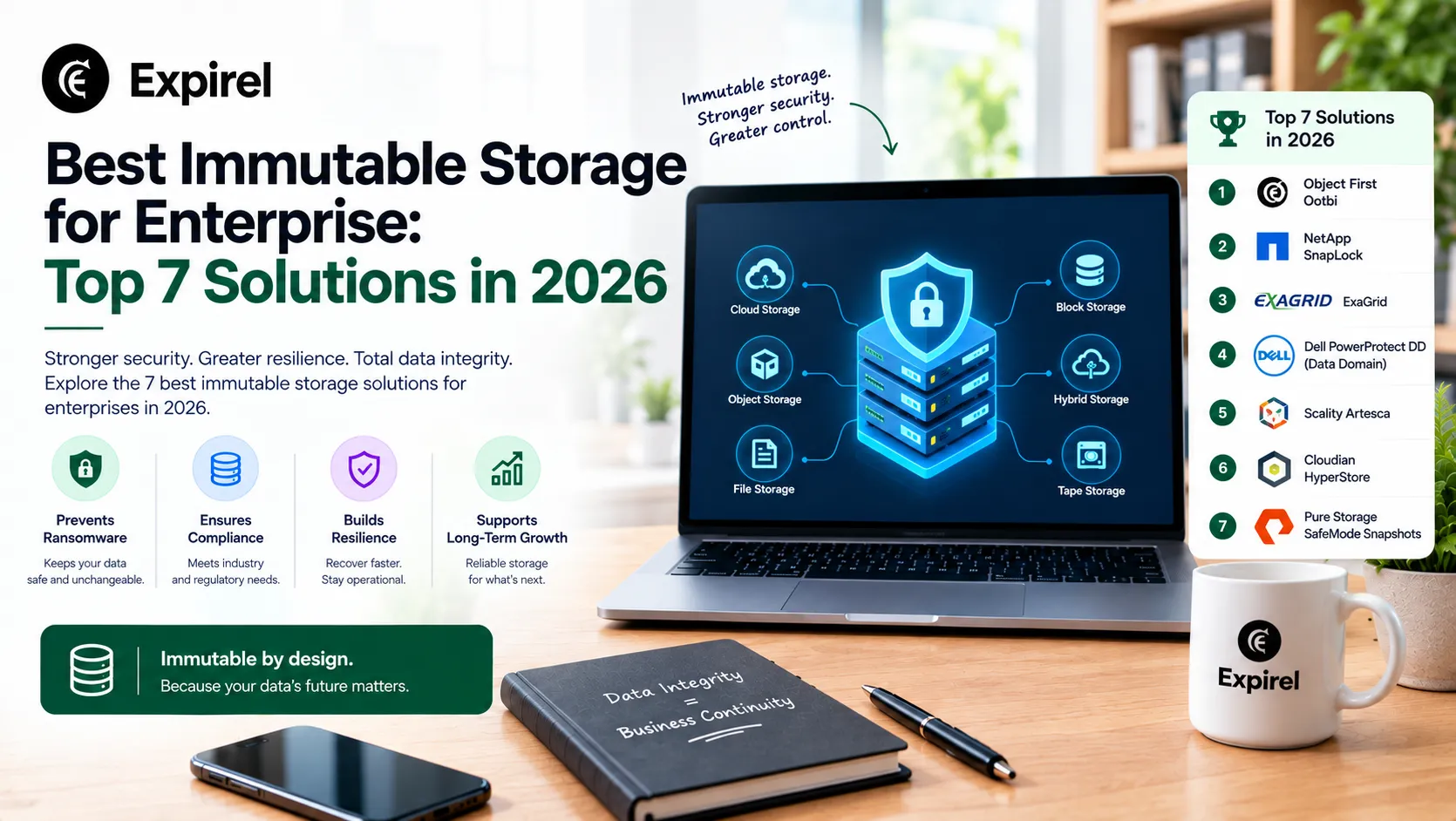
Immutable storage data that cannot be modified or deleted for a defined retention period used to live almost entirely in compliance departments. SEC Rule 17a-4, HIPAA retention requirements, and e-discovery obligations created the original market, and for years the buyers were auditors and records managers, not security teams.
Ransomware changed who's actually buying it. According to Veeam's Data Protection Trends research, 96% of ransomware attacks now specifically target backup repositories, and 76% of those attempts succeed in compromising them. The playbook is blunt: destroy the backups first, then trigger encryption, then demand payment, knowing recovery without paying is no longer an option. Immutable storage is the direct countermeasure: data that physically cannot be deleted, no matter whose credentials are used to request it.
The market has matured quickly in response. Solutions now span purpose-built backup appliances, primary storage WORM platforms, enterprise object storage with S3 Object Lock, tiered backup with network isolation, and all-flash platforms using vendor-authorized eradication. These categories protect different things, enforce immutability through different mechanisms, and suit different buyers, which is exactly why picking the wrong category is the most common mistake in this evaluation.
The One Question That Actually Separates Real Immutability From Marketing
Before comparing products, it's worth fixing the test that matters, because vendors use "immutable" loosely:
If an attacker had full administrative credentials right now, what specifically prevents them from deleting data committed an hour ago?
Policy-based retention that an admin with the right access level can modify is not immutable storage in any meaningful security sense it's a soft barrier, and ransomware operators have repeatedly proven they can defeat exactly that kind of barrier once they hold admin credentials. Every solution worth evaluating has a specific, verifiable answer to that question: a hardware lock, a network isolation window, a vendor-authorization step, or WORM file-system semantics enforced below the software layer. If a vendor can't answer that question concretely, that's the tell.
7 Enterprise Immutable Storage Solutions Worth Evaluating
1. Object First Ootbi
Object First Ootbi is the only purpose-built immutable backup storage appliance designed exclusively for Veeam environments. It ships as a 2U appliance (18TB per node, clusterable to 1.7PB) and enforces what the company calls Absolute Immutability through three independent mechanisms running simultaneously: S3 Object Lock in compliance mode at the protocol layer, an OS-level block preventing root access through any software path, and hardware-locked firmware that can't be modified to introduce an override.
The value of three independent layers is that compromising one doesn't compromise the others. An attacker holding full storage-admin credentials still hits the protocol lock. One who somehow bypasses the protocol hits the OS block. One who compromises the OS finds firmware they can't rewrite. No single software path leads to deletion within the retention window.
Ootbi holds the full Veeam Ready certification stack — Object, Repository, SOSAPI, and IAM STS plus ZTDR (Zero Trust Data Resilience) certification. Setup is reportedly around 15 minutes.
Best for: organizations running Veeam who want a purpose-built appliance rather than adapting general-purpose storage to the job.
2. NetApp SnapLock
NetApp SnapLock is the WORM and compliance feature set built into ONTAP, the operating system running across NetApp's AFF (all-flash), FAS (hybrid), and StorageGRID (object storage) platforms. It's one of the most widely deployed immutable storage technologies in the enterprise, with a compliance track record spanning more than two decades in regulated industries.
SnapLock Compliance mode creates volumes where committed files genuinely cannot be deleted or modified by any user, including the storage administrator, until the retention period expires, and that clock cannot be shortened. Even the SnapLock delete operation requires a privilege distinct from standard admin rights, and a compliance volume can't be destroyed until all WORM data on it has expired. This architecture supports certification under SEC 17a-4(f), FINRA, MiFID II, CFTC, and comparable regulations globally.
Best for: organizations already running ONTAP infrastructure, where SnapLock is frequently the lowest-friction path to immutable storage since no new hardware is required.
3. ExaGrid
ExaGrid uses a two-tier architecture built specifically to defeat backup-targeting ransomware. Incoming backups land in a Landing Zone optimized for fast restores. After a configurable delay, data moves into the Retention Time-Lock tier, a network-isolated zone that becomes read-only and unreachable from the network for the entire retention window.
Network isolation matters because it defeats credential-based attacks specifically: an attacker who has compromised both the backup application server and the storage admin account still can't reach the Retention Time-Lock tier, because it's simply not on the network during the lock period. That's a structurally different defense than a permissions setting an attacker with admin rights could theoretically override.
Best for: multi-application environments needing broad backup-platform compatibility (Veeam, Commvault, Veritas NetBackup, Dell EMC NetWorker, IBM Spectrum Protect) plus deduplication savings at long retention periods.
4. Dell PowerProtect DD (Data Domain)
Dell PowerProtect DD, formerly Data Domain, is among the most widely deployed purpose-built backup appliances in the enterprise market. Its immutability feature, DD Retention Lock, offers Compliance and Governance modes. In Compliance mode, locked files can't be modified, overwritten, renamed, or deleted by any user, including administrators, until the retention period expires, and that period can't be shortened once a file is locked.
DD Retention Lock Compliance is independently qualified against SEC 17a-4(f), HIPAA, GDPR, and other major regulatory frameworks, and DD Boost integration extends across Veeam, Commvault, Veritas NetBackup, and IBM Spectrum Protect.
Best for: organizations standardized on Dell infrastructure who want simplified procurement and support alongside proven immutability.
5. Scality Artesca
Scality Artesca is software-defined S3 object storage built around a cyber vault concept: a dedicated, air-gappable immutable tier deployed separately from primary production storage. It implements S3 Object Lock in both compliance and governance modes on commodity x86 hardware, avoiding a proprietary appliance requirement entirely.
It scales from small edge deployments (three-node minimum) up to data-center scale, and supports hybrid configurations extending the on-premises immutable repository to cloud object storage with consistent Object Lock semantics across both tiers.
Best for: organizations wanting cyber-vault-style protection without committing to proprietary hardware.
6. Cloudian HyperStore
Cloudian HyperStore is an enterprise S3-compatible object storage platform implementing S3 Object Lock at petabyte scale. In compliance mode, retention locks can't be shortened or removed by any user, including administrators.
It includes operational features uncommon in immutable backup storage specifically: multi-tenancy with tenant-level isolation, QoS controls, erasure coding across sites, and multi-site replication that preserves Object Lock semantics across every site.
Best for: large-scale, multi-tenant deployments — particularly financial services and healthcare organizations needing immutability across both backup and regulatory archiving.
7. Pure Storage SafeMode Snapshots
Pure Storage SafeMode adds snapshot immutability to Pure FlashArray and FlashBlade platforms through vendor-authorized eradication: permanently deleting a SafeMode-protected snapshot requires contacting Pure Storage support directly, introducing a mandatory delay and out-of-band human verification.
The architecture is meaningfully different from S3 Object Lock or a retention policy: SafeMode doesn't store a retention setting inside the system that an attacker might eventually find a way to modify. The override lives entirely outside the storage system, in Pure's support organization, reachable only through a separate authentication channel.
Best for: organizations already running Pure FlashArray or FlashBlade who want immutable snapshot protection without adding hardware.
How to Match the Solution to Your Actual Requirement
These seven aren't interchangeable. Work from your use case, not a feature checklist:
Backup-specific immutability for Veeam environments: Ootbi is the purpose-built answer, with the strongest hardware-enforced guarantee in this category and zero-friction Veeam certification.
Compliance archiving on existing NetApp infrastructure: SnapLock Compliance is the lowest-friction option — it runs on hardware you likely already own and carries the deepest regulatory certification portfolio here.
Multi-application environments needing deduplication: ExaGrid for network-isolation-based protection with storage savings, or PowerProtect DD for deeper compliance certification and Dell ecosystem integration.
Immutable object storage on commodity hardware: Scality Artesca for backup-centric cyber vault deployments; Cloudian HyperStore for petabyte-scale, multi-tenant environments with regulatory archiving needs.
All-flash primary storage already in place: Pure Storage SafeMode adds real immutable snapshot protection with no additional hardware.
A Practical Evaluation Framework
Before shortlisting vendors, work through these questions in order:
1. What's actually being protected: backups, primary storage, or both? A backup-specific appliance and a primary-storage WORM platform solve different problems even when both claim "immutable."
2. What's your existing infrastructure? Existing NetApp or Pure deployments make their native immutability options (SnapLock, SafeMode) far lower-friction than introducing a new appliance.
3. Which specific regulations apply to you? SEC 17a-4(f), HIPAA, and GDPR certification status varies by vendor; confirm the specific certification your compliance team needs, not just "compliance mode" as a marketing term.
4. Can you answer the credential-attacker test for this specific product? Ask the vendor directly: what stops someone with full admin access from deleting data an hour after it's committed? A vague answer is a red flag regardless of how polished the rest of the pitch is.
5. What's your actual retention and scale requirement? Petabyte-scale multi-site needs point toward object storage platforms; single-appliance Veeam environments point toward purpose-built options.
Mistakes Organizations Make Evaluating Immutable Storage
Treating "immutable" as a single, interchangeable feature. Policy-based retention, S3 Object Lock, network isolation, and vendor-authorized eradication are structurally different defenses with different failure modes — confirm which one a vendor is actually offering.
Buying for compliance and assuming ransomware protection follows automatically. A platform certified for SEC 17a-4(f) was built for a different threat model than one built to survive a credentialed ransomware attacker — check both if you need both.
Skipping the credential-attacker question during evaluation. Asking about certifications and integrations is easy. Asking exactly what stops an admin-level attacker from deleting an hour-old backup is the question that actually separates the seven solutions here from weaker alternatives.
Ignoring existing infrastructure fit. A best-in-category product that requires new hardware and new operational training can lose to a lower-friction option already native to your environment.
The Bottom Line
Across all seven solutions, the underlying requirement never changes: enterprise immutable storage has to enforce retention at a layer software can't override, including software running with legitimate administrative credentials. That's the actual dividing line between genuine immutable storage and retention-policy-as-marketing. The right solution isn't the one with the longest feature list it's the one whose answer to "what stops an attacker with full access from deleting this right now" fits your specific infrastructure, regulatory environment, and threat model.

Fahad Ahmad
Founder of EXPIREL · Digital Entrepreneur · Product Management Specialist
Fahad Ahmad is the founder of EXPIREL and a digital entrepreneur with over 10 years of experience in SaaS development, SEO, and digital product creation. He focuses on building practical solutions that help individuals and businesses manage product expiration dates, organize inventory, track habits, and improve daily productivity.
Through EXPIREL, Fahad shares actionable guides, product management tips, barcode scanning tutorials, and research-backed insights designed to help users reduce waste, stay organized, and make smarter decisions.
Related Articles
View all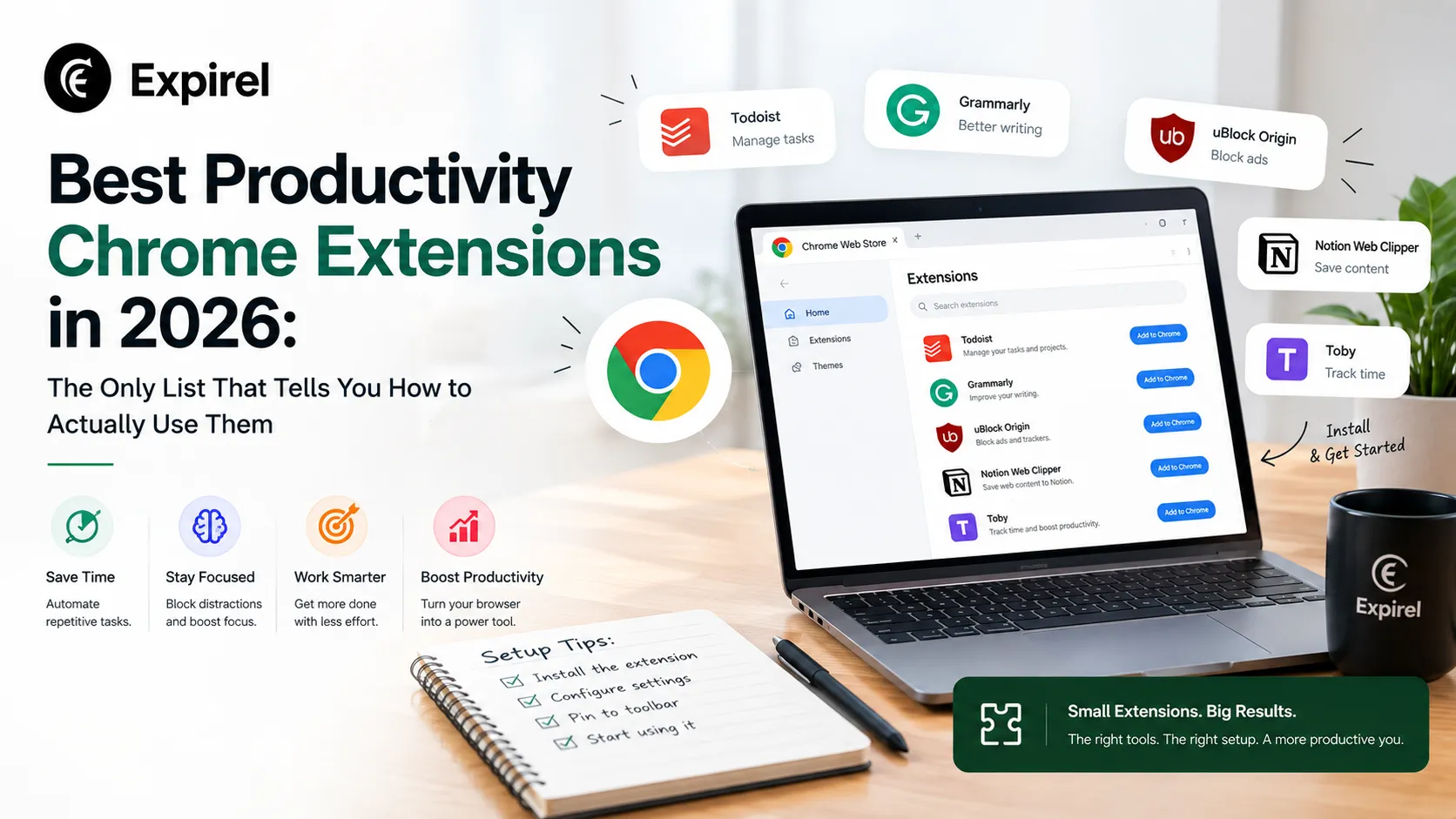
Best Productivity Chrome Extensions in 2026: The Only List That Tells You How to Actually Use Them
September 8, 2026
13 Best productivity Chrome extensions in 2026 with setup tips, privacy ratings, Cold Turkey vs StayFocusd, Google extensions, and persona-based picks.

Best Productivity Planners: A Research-Backed Guide for 2026
July 21, 2026
Which productivity planner actually fits how you work? Compare 15 top picks for ADHD, iPad, work, and paper by price, pros, and cons.
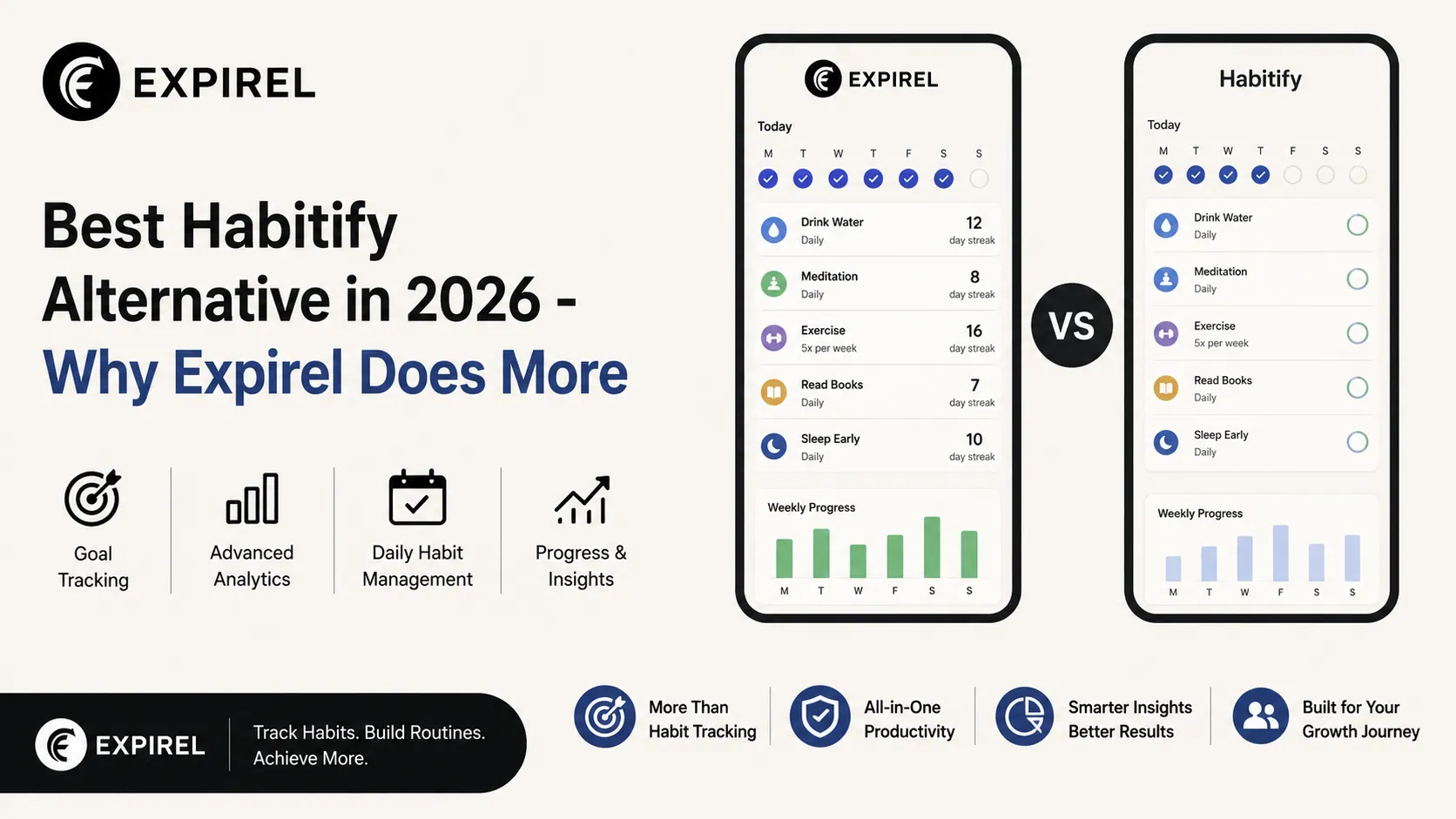
Best Habitify Alternative in 2026 - Why Expirel Does More
June 10, 2026
Habitify limits you to 3 habits on the free plan. Discover Expirel, the free habit and expiry tracker that does more, without the paywall.