Dinner Productivity vs Productivity Recipe: What Is the Difference and Which One Do You Actually Need?
Not sure how dinner productivity and a productivity recipe differ? This guide compares both clearly, shows how they work together, and links.
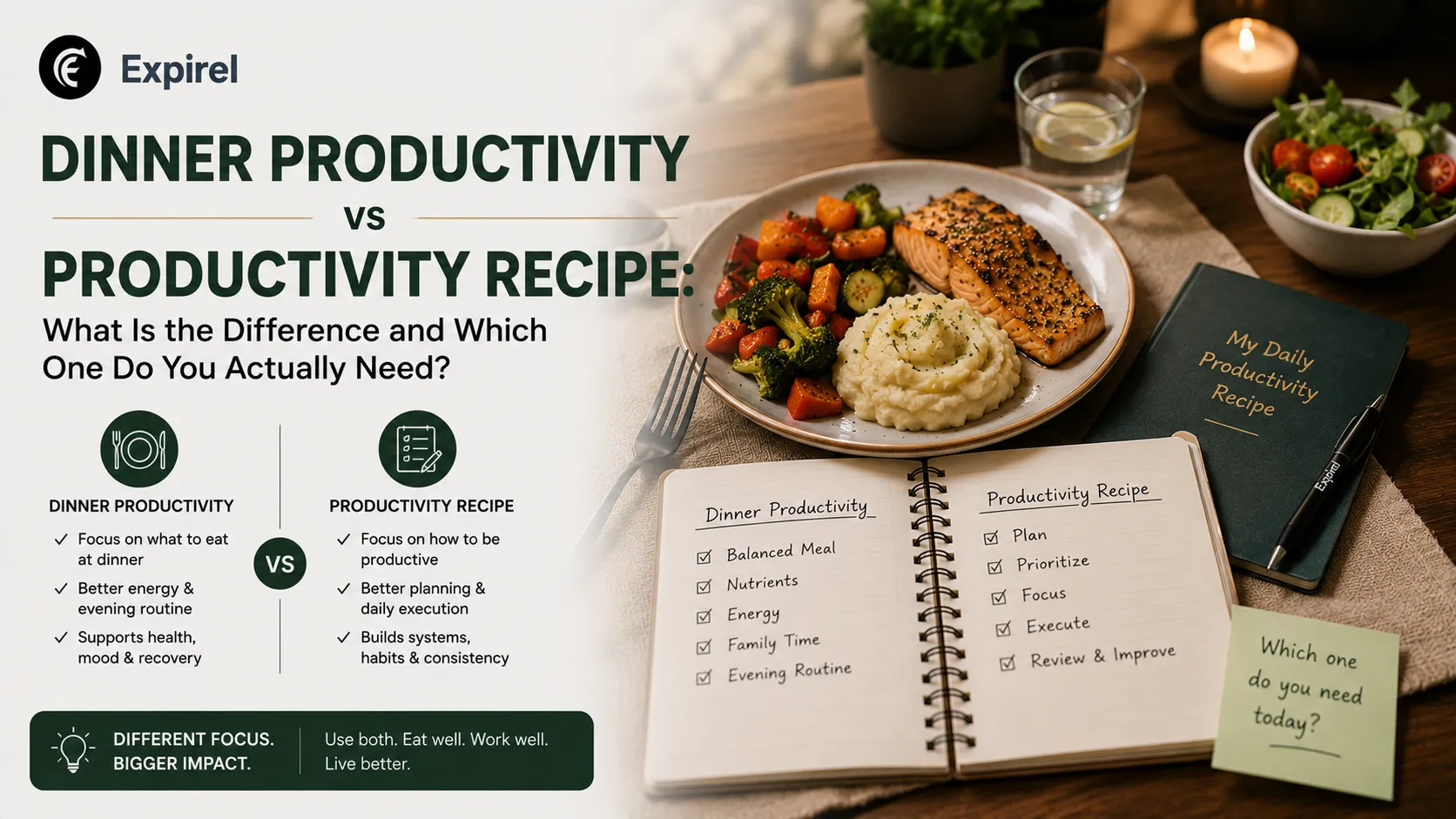
Dinner productivity refers to how your evening meal directly affects your sleep quality and next-day cognitive performance it is a nutrition and timing strategy. A productivity recipe is a structured, repeatable daily work system with specific steps and habits it is a scheduling and behaviour framework. One is about what you eat. The other is about how you work. Neither is better than the other they solve fundamentally different problems and produce compounding results when used together. Both guides on this site cover each system in full, and this article tells you which one to start with first.
What Is Dinner Productivity?
Dinner productivity is the practice of using your evening meal deliberately to support overnight recovery and next-day cognitive output. It is built on a straightforward biological principle: your brain does its most critical consolidation work memory formation, emotional regulation, cognitive reset during slow-wave sleep. What you eat at dinner determines the quality of that sleep stage, which determines the quality of everything that follows the next morning.
The focus is entirely on the nutritional and timing side of your evening. It answers questions like: which foods support deep, restorative sleep? Specifically, tryptophan-rich proteins (chicken, turkey, eggs) that the brain converts to serotonin and then melatonin, the primary sleep hormone. Which foods disrupt it? High glycaemic carbohydrates eaten close to bedtime that spike blood glucose, causing hormonal disruption during the critical early sleep cycles. What role does magnesium play? It is the mineral most directly linked to the quality of sleep architecture, and it is deficient in most Western diets. When should you eat relative to bedtime and your natural circadian rhythm? The answer is 2 to 3 hours before sleep onset, allowing full digestion before the body's core restoration processes begin.
Dinner productivity is not a diet plan, and it is not about weight management. It is a targeted nutritional strategy whose single goal is improving the cognitive output, specifically executive function, working memory, and sustained attention available to you the following morning.
Covers the science, 4 original productivity dinner recipes, what to eat, what to avoid, the meal timing framework, and a 5-column Google Sheets tracker for measuring the dinner-to-performance correlation.
Dinner productivity is a nutrition strategy. It improves what your brain has to work with tomorrow by improving what your body recovers with tonight.
What Is a Productivity Recipe?
A productivity recipe is a structured, repeatable daily work framework a fixed set of habits, time blocks, and rituals that govern how your working day runs from start to finish. The word recipe is used deliberately: just as a good kitchen recipe removes improvisation and guarantees a consistent result, a productivity recipe removes daily decision-making about how to work and replaces it with a proven system. This approach applies the same principle as implementation intentions the behavioural psychology concept showing that pre-deciding exactly when, where, and how you will act increases follow-through rates by 200 to 300 percent compared to motivation-based intention alone.
The framework has specific ingredients: a fixed start ritual that signals the brain the work period has begun, a single daily priority identified the night before rather than improvised in the morning, two 90-minute deep work blocks aligned to the ultradian rhythm, batched communication windows that prevent reactive interruption and reduce cognitive load, and a defined shutdown ritual that closes open mental loops before the evening begins.
A productivity recipe answers the structural questions about your working day. It addresses cognitive load directly by removing daily decisions about when to do what. It protects deep work the high-value, cognitively demanding tasks that produce real results from the constant interruption that defines reactive working patterns. And it creates a defined endpoint that prevents work stress bleeding into the dinner and sleep window, which is precisely where it would undermine the other half of the system.
Covers the complete 8-step daily framework, deep work block structure, the shutdown ritual, a Google Sheets productivity tracker template, and how to track the system consistently.
A productivity recipe is a system strategy. It determines how you use the cognitive resources available to you on any given day regardless of how those resources arrived.
Dinner Productivity vs Productivity Recipe: Full Comparison
Here is the complete dinner productivity vs productivity recipe breakdown across every dimension that matters for understanding how these two concepts differ and how they connect.
Dimension | Dinner Productivity | Productivity Recipe |
What it is | A nutrition and timing strategy for your evening meal | A structured daily work system with fixed habits and rituals |
Core question | What should I eat to perform better tomorrow? | How should I structure my day to do my best work? |
Primary focus | Food, sleep quality, overnight recovery | Time blocks, task priority, deep work, shutdown |
Time of day | Evening — dinner time and pre-sleep window | Entire working day from start ritual to shutdown |
Scientific base | Sleep medicine, nutritional neuroscience, circadian biology | Behavioural psychology, cognitive science, ultradian rhythm research |
What it improves | Sleep depth, morning energy, next-day focus and mood | Task completion rate, deep work hours, end-of-day clarity |
What it does NOT do | Fix a poorly structured work day | Fix poor sleep from a bad evening meal |
How fast it works | Noticeable sleep quality changes within 3 to 7 days of consistent change | Meaningful workflow improvement within 10 to 14 days of consistent use |
Key metric | Next-day energy score (1 to 5) tracked each morning | Daily priority completion rate and actual deep work hours logged |
Tool recommended | Google Sheets dinner-energy tracker or Expirel Habit Tracker | Google Sheets productivity tracker or Expirel Habit Tracker |
How Dinner Productivity and a Productivity Recipe Work Together
This is the part most people miss when they encounter these two concepts separately: they are not alternatives. They are two halves of a closed loop. One without the other produces results that plateau quickly and break down under pressure.
The research connecting these two systems
Two evidence-based findings establish why these systems reinforce each other:
(1) Research published in the Journal of Clinical Sleep Medicine by Grandner et al. (2016) found significant correlations between evening dietary quality. It disrupted slow-wave sleep the sleep stage most critical for memory consolidation and next-morning executive function. This directly links what you eat at dinner to the cognitive capacity available when your productivity recipe begins the following morning.
(2) The 90-minute deep work block in the productivity recipe aligns with the ultradian rhythm the biological 90-minute cycle governing human attention and alertness documented extensively in sleep and cognitive science research. Working with this cycle rather than against it produces more high-quality output with less cognitive fatigue than working in longer, unstructured sessions.
These two findings together explain why the combined system compounds: the dinner improves the sleep, the sleep improves the morning cognitive baseline, the morning baseline improves the depth of the deep work blocks, and the clean shutdown at the end of the work day improves the quality of the dinner window that follows. Each loop reinforces the next.
Here is how the loop works in practice:
Evening: How the Shutdown Ritual Connects to Dinner
Your productivity recipe includes a shutdown ritual at the end of each working day. That ritual closes open cognitive loops, identifies tomorrow's single priority, and prepares your workspace for the next session. Immediately after the shutdown ritual, you eat dinner and that dinner either supports or undermines the sleep quality that determines what cognitive resources are available when tomorrow's productivity recipe begins.
In short: the shutdown ritual ends the productivity recipe and starts the dinner productivity window. Without the shutdown ritual, the dinner window arrives while your mind is still running open work loops and those loops disrupt sleep regardless of what you ate. Without the productive dinner, the shutdown ritual closes properly but the sleep it feeds into is poor, and the next morning's start ritual begins from a depleted cognitive baseline.
Morning: Where Both Systems Meet
Your productivity recipe begins each morning with a fixed start ritual and a review of the priority you identified the night before. The quality of that morning start your clarity, focus, and decision-making speed is directly determined by the sleep you got, which was directly determined by your dinner. A well-executed dinner productivity practice feeds a higher quality morning start ritual. A well-structured start ritual makes the rest of the productivity recipe day run more cleanly.
People who implement both together consistently report a compounding effect that neither system produces alone: the dinner improves the sleep, the sleep improves the morning, the morning improves the workday, and the workday's clean shutdown improves the evening. Within three to four weeks, the cycle becomes self-reinforcing rather than requiring constant willpower to maintain.
Dinner productivity and a productivity recipe are not competing systems. They are the evening and daytime halves of one closed loop. Each one makes the other more effective than it would be in isolation.
Which One Should You Focus on First?
If you are starting from scratch or your current system is not working, here is an honest framework for deciding where to begin. Most people try to implement both at once and abandon both within two weeks. Start with the one that addresses your most obvious current gap.
Start with dinner productivity if... | Start with a productivity recipe if... |
You wake up tired even after 7 to 8 hours of sleep | You have good energy but the day feels chaotic and reactive |
You feel mentally foggy before 10 am most mornings | You consistently reach the end of the day without finishing your most important task |
You eat dinner late (within 90 minutes of sleep) most nights | You have no fixed start or end point to your working day |
You regularly drink alcohol in the evening | You check email or messages first thing every morning before doing focused work |
Your energy crashes sharply in the early afternoon | You work long hours but feel you have little to show for them |
You have not tracked what you eat against how you feel the next day | Your motivation is inconsistent, good days and bad days with no clear pattern |
If most of your answers fall in the left column, start with the dinner productivity guide. Fix the nutritional foundation first. If most fall in the right column, start with the productivity recipe guide. Fix the structural system first. If you are genuinely split between both columns, start with the productivity recipe because a structured workday creates a natural shutdown point, and the shutdown point creates the mental space to make better dinner decisions. The structure tends to improve the nutrition by giving the evening a clear beginning.
How to Use Both Together: A Combined Daily System
Once you have implemented one system consistently for three weeks, adding the second becomes straightforward because you already have an anchor point for it. Here is how a typical day looks when both systems are running well:
Morning (productivity recipe start ritual): wake at a consistent time, complete your fixed start ritual (3 to 5 actions before opening any application), review the single priority you set the night before, block two 90-minute deep work windows in your calendar.
Deep work block 1 (productivity recipe): single-task on your priority with notifications off. No email, no messages, no context switching.
Communication window 1: process messages, make decisions, reply. Then stop.
Deep work block 2 (productivity recipe): second most important task or continued priority work under the same focused conditions.
Communication window 2 and wrap-up: second message batch. Final task clearance.
Shutdown ritual (productivity recipe — end): clear incomplete tasks, set tomorrow's single priority, close all work applications. The working day is now officially over.
Dinner window (dinner productivity — begins): eat a productive meal 2 to 3 hours before intended sleep. Lean protein, complex carbohydrates, magnesium-rich vegetables. No alcohol. No heavy refined carbohydrates close to bedtime.
Pre-sleep window: no screens for 30 to 60 minutes before sleep. The shutdown ritual and the productive dinner together clear both the cognitive and the physical load before sleep begins.
Next morning: the cycle repeats from step 1, but from a higher cognitive baseline than yesterday because the sleep was better.
Track both systems in one place with Expirel
Expirel's Habit Tracker lets you log both systems as separate daily habits for productivity recipe steps (start ritual done, priority set, deep work block completed, shutdown ritual done) and dinner productivity habits (productive dinner eaten, dinner timing met, alcohol avoided). Seeing both streaks in one view makes the connection between evening choices and daytime performance visible in real data. Most people who track both together notice the dinner-to-energy correlation within 10 to 12 days faster than tracking either system in isolation.
Common Mistakes People Make When Confusing the Two
Treating them as the same topic. Dinner productivity is nutrition science. A productivity recipe is behavioural science. Applying a nutrition solution to a scheduling problem or a scheduling solution to a nutrition problem produces no result. Diagnose which gap you have before choosing which system to implement.
Implementing both on the same day. Two new systems at once is the most common reason people abandon both. Each system requires building new habits across 10 to 21 days before they become automatic. Start with one, hold it for three weeks, then add the second. The sequencing matters more than the speed.
Assuming the productivity recipe compensates for poor sleep. No scheduling system can recover the cognitive capacity lost to disrupted sleep. If your mornings consistently feel foggy and your deep work blocks consistently underperform, the issue is almost certainly upstream in the dinner and sleep window — not in the recipe itself.
Assuming a good dinner compensates for a chaotic work structure. Excellent nutrition gives you more cognitive resources to work with. But if those resources are spent on reactive email, constant context switching, and no clear priorities, the nutritional benefit is real but its output is wasted. Both systems are necessary for the compounding effect to appear.
Not tracking either system. Feeling roughly good or roughly bad is too imprecise to identify which variable is causing the problem. Tracking dinner quality and next-day energy scores separately from productivity recipe completion rates gives you real data within two weeks. The pattern becomes obvious in the data even when it is invisible to daily self-assessment.
Conclusion
Dinner productivity and a productivity recipe are the clearest example of two systems that individually produce good results and together produce compounding ones. The nutrition improves the sleep. The sleep improves the morning. The morning improves the work. The work's clean closure improves the evening. The evening improves the dinner. And the cycle runs again, from a slightly higher baseline each time.
Most people try one or the other, see limited results, and conclude that productivity systems do not work for them. Understanding the dinner productivity vs productivity recipe distinction clearly, as this guide does, reveals that the real issue is almost always that they used half the system. Both halves are straightforward to implement. Neither requires expensive tools, dramatic lifestyle changes, or exceptional discipline. They require consistency, which is exactly what a habit tracker is designed to produce.
If you have read this far, you now know more about the relationship between these two systems than most people who have spent years trying to optimise their productivity. The next step is to choose one guide, implement it for three weeks, and measure what changes. The data will tell you everything after that.
Frequently Asked Questions
Q: What is the difference between dinner productivity and a productivity recipe?
Dinner productivity is a nutrition and timing strategy focused on what you eat at dinner to improve slow-wave sleep quality and next-day executive function. A productivity recipe is a structured daily work framework covering start rituals, 90-minute deep work blocks aligned to the ultradian rhythm, and a shutdown routine. One addresses what your brain recovers with overnight. The other governs how it performs during the day. Both are evidence-based systems that solve different problems.
Q: Which should I focus on first dinner productivity or a productivity recipe?
Start with dinner productivity if you wake tired despite adequate sleep, feel cognitively foggy before 10 am, or regularly eat within 90 minutes of bedtime. Start with a productivity recipe if your energy is reasonable but your days feel reactive and unstructured. When genuinely unsure, begin with the productivity recipe its shutdown ritual creates a defined workday endpoint that naturally improves dinner timing and evening quality.
Q: Can I combine both systems without abandoning one?
Hold one system for 21 days before adding the second. Implementation intentions research shows that pre-deciding exactly how and when you will act increases follow-through by 200 to 300 percent but that effect requires the habit to be automatic first. Building two new systems simultaneously splits your cognitive load and is the most consistent reason people abandon both within two weeks.
Q: How does dinner directly affect next-day cognitive performance?
Evening food choices affect slow-wave sleep quality the stage most critical for memory consolidation and executive function. Grandner et al. (2016), published in the Journal of Clinical Sleep Medicine, found significant correlations between high glycaemic evening diets and disrupted sleep architecture. Tryptophan-rich proteins support melatonin synthesis. Magnesium-rich vegetables support sleep depth. The combined effect produces measurably better working memory, attention, and decision-making the following morning.
Q: What is a productivity recipe and how does it reduce cognitive load?
A productivity recipe is a repeatable daily work framework with five pre-decided components: a fixed start ritual, one prioritised task identified the night before, two 90-minute deep work blocks aligned to the ultradian rhythm, batched communication windows, and a shutdown ritual. Pre-deciding all of these reduces daily cognitive load significantly each decision you remove from the working day frees executive function for the work itself. The full 8-step system is in the dedicated productivity recipe guide.
Q: Is dinner productivity the same as a productivity diet?
Related but distinct. A productivity diet covers nutritional choices across all daily meals breakfast, lunch, snacks, and dinner optimised for sustained cognitive performance throughout the working day. Dinner productivity focuses specifically on the evening meal and its downstream effect on overnight slow-wave sleep, circadian rhythm alignment, and next-morning executive function. Dinner productivity is the highest-impact component of a complete productivity diet because it directly governs overnight recovery.
Q: How do I track both systems in one place?
Log both as separate daily habits in Expirel's Habit Tracker. For dinner productivity: did I eat a tryptophan and magnesium-rich meal at least 2 hours before sleep? Rate next-day energy 1 to 5 each morning. For the productivity recipe: start ritual complete, priority set, deep work block done, shutdown ritual complete. The dinner-to-energy correlation becomes visible in the data within 10 to 12 days and changes behaviour faster than advice alone.
Q: How long before both systems produce compounding results?
Dinner productivity produces measurable sleep and energy improvements within 3 to 7 days, particularly from eating earlier and increasing magnesium intake. The productivity recipe shows workflow improvement within 10 to 14 days of consistent use. The compounding effect of both systems running together typically becomes clearly visible at 3 to 4 weeks, when improved sleep quality starts consistently feeding higher-quality deep work blocks in a self-reinforcing daily loop.
Q: Are there Google Sheets templates for tracking both systems?
Both individual guides on this site include tracker structures. The dinner productivity guide covers a 5-column dinner-energy correlation tracker. The productivity recipe guide covers a daily habit completion tracker. Combine them in one Google Sheet with two tabs, or use Expirel's Habit Tracker to consolidate everything into one daily check-in. The key metric across both: the correlation between your dinner quality score each evening and your next-day energy score each morning.

Fahad Ahmad
Founder of EXPIREL · Digital Entrepreneur · Product Management Specialist
Fahad Ahmad is the founder of EXPIREL and a digital entrepreneur with over 10 years of experience in SaaS development, SEO, and digital product creation. He focuses on building practical solutions that help individuals and businesses manage product expiration dates, organize inventory, track habits, and improve daily productivity.
Through EXPIREL, Fahad shares actionable guides, product management tips, barcode scanning tutorials, and research-backed insights designed to help users reduce waste, stay organized, and make smarter decisions.
Related Articles
View all
AI Productivity Tools Update 2026–2027: What Works, What Changed, and What to Use Right Now
September 18, 2026
AI productivity tools in 2026 and heading into 2027. What they mainly reduce the best tools by role, free options, and how to evaluate any tool before adopting.
AI Chatbot for Productivity: Complete 2026 Guide: Research, Pricing, and Which One Actually Works for You
September 29, 2026
Verified 2026 pricing, peer-reviewed research, and honest comparisons of the best AI chatbots for productivity, customer service, and website engagement.
Best Productivity Apps for Students in 2026: Top 10 by Need
October 5, 2026
Find the best productivity apps for students in 2026: top 10 picks, free options, real costs, and setups for college, PhD, law, medical, and high school.