Which Drugs Should Never Be Used Past Their Expiration Date
Not all expired medicine is equally risky. See exactly which drugs turn toxic or fail dangerously after their date, and what to do instead.
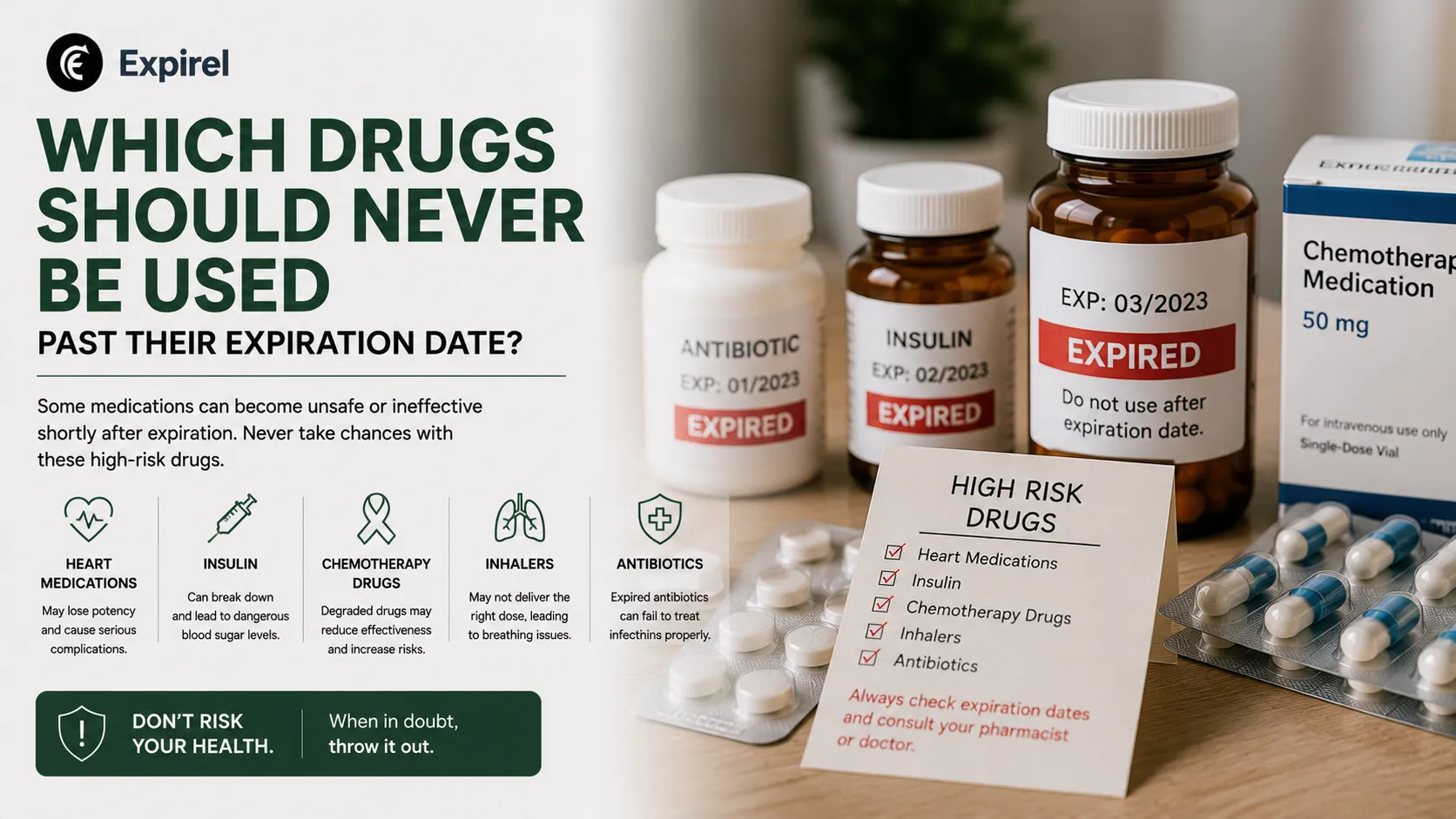
Most medicine does not become dangerous the day it expires. It just slowly loses strength, which is a real problem but usually not a sudden one. A specific, shorter list of drugs breaks that pattern entirely, either by degrading into something actively toxic or by losing potency in a situation where losing even a small amount of strength can be life-threatening. This article is about that shorter, higher-stakes list, which drugs belong on it, why each one is dangerous specifically, and what to do instead of gambling on an old bottle.
If you are trying to figure out whether medicine in general is still good after its date, our companion guide on how long medicine stays good after its expiration date covers that broader question. This article goes narrower and deeper: the specific drugs where the general "often still fine" rule does not apply, and why.
Drugs That Should Never Be Used Expired
Drug or Drug Class | Why It Is Dangerous Expired |
|---|---|
Tetracycline antibiotics (including old doxycycline) | Degrades into compounds documented to cause kidney injury, including Fanconi syndrome |
Liquid or reconstituted antibiotics | Loses potency fast once mixed, risking an under-treated infection and antibiotic resistance |
Epinephrine auto-injectors (EpiPen) | Reduced dose in a severe allergic reaction can be the difference between survival and death |
Insulin | Degrades in ways invisible to the eye; under-dosing a diabetic emergency is dangerous |
Nitroglycerin | Loses potency quickly; unreliable for treating acute chest pain |
Warfarin and other blood thinners | A narrow therapeutic index drug; even small potency shifts risk clotting or bleeding |
Levothyroxine (thyroid medication) | Narrow therapeutic index; degraded doses destabilise heart rate and metabolism |
Anti-seizure medications (phenytoin, carbamazepine) | Narrow therapeutic index; reduced potency can trigger breakthrough seizures |
Digoxin and lithium | Narrow therapeutic index; small dosing errors carry serious cardiac or neurological risk |
Why This Specific List Exists: The Narrow Therapeutic Index Explanation
Most of the drugs on the list above share one property that rarely gets explained clearly: they belong to a category the FDA calls Narrow Therapeutic Index, or NTI, drugs. For a typical medicine, losing 10 percent of its strength is a minor inconvenience. For an NTI drug, that same 10 percent can be the entire gap between a safe dose and a dangerous one, in either direction.
Warfarin is the clearest example. Doctors adjust warfarin doses in small increments based on regular blood tests measuring how well the blood is clotting. If an expired tablet has degraded and delivers less active drug than expected, the patient is effectively taking a lower, unmonitored dose. Blood can clot more easily than intended, which is a genuine stroke risk for someone with a mechanical heart valve or atrial fibrillation. Levothyroxine works the same way in the opposite direction: because thyroid hormone regulates heart rate and metabolism so precisely, even a fractional drop in delivered dose can measurably affect how someone feels within weeks.
This is not a fringe classification. The FDA has published specific bioequivalence standards for NTI drugs precisely because normal, acceptable variation for other medicines is not acceptable here. If a drug requires regular blood monitoring to check its level in your system, such as an INR test for warfarin or thyroid panel for levothyroxine, that is a strong sign you are dealing with an NTI drug and should never use an expired supply.
Drugs That Actively Turn Toxic: The Tetracycline Case
Tetracycline-class antibiotics are the clearest documented case of a drug that does not just weaken with age, it changes into something actively harmful. Medical case reports describe Fanconi syndrome, a disorder affecting how the kidneys reabsorb nutrients, following ingestion of degraded, expired tetracycline. This finding has been replicated across multiple published case series since the 1960s, which is why this specific drug class carries a firmer warning than most other antibiotics.
The practical lesson from tetracycline is broader than one drug. It proves that degrading potency and degrading safety are two separate questions, and a medicine can fail on the second one even while still containing measurable active ingredient. This is exactly the distinction that gets lost in most general advice about expired medicine, which tends to focus only on whether a drug still works, not whether its breakdown products are themselves a new source of harm.
A Smell Test That Does and Does Not Work: Aspirin
Old aspirin tablets sometimes develop a faint vinegar smell, caused by hydrolysis, a reaction where moisture breaks acetylsalicylic acid down into salicylic acid and acetic acid. This is a real, well-documented chemical reaction, and it is a genuinely useful signal that a specific bottle of aspirin has started to degrade. What it does not mean is that a mild vinegar smell makes aspirin acutely dangerous the way expired tetracycline is. The smell mainly indicates reduced potency and, in some cases, mild stomach irritation from the breakdown products, not the kind of organ-level toxicity documented with tetracycline. The distinction matters: a vinegar smell is a reason to replace the bottle, not a medical emergency.
Devices and Injectables: Where the Delivery Mechanism Is the Risk
Epinephrine auto-injectors and insulin belong on the never-use-expired list for a different reason than tetracycline. The drug itself degrading is only part of the concern. The bigger issue is that both are used in situations where there is no time or ability to test whether the dose actually worked before the consequences arrive. An expired EpiPen used during anaphylaxis, or expired insulin used during a severe blood sugar swing, might still deliver a partial dose, but you will not know how much of one until the emergency is already unfolding. That is a fundamentally different risk profile than a headache reliever that simply works a little less well.
Nitroglycerin follows the same logic. It is specifically flagged in pharmacological stability research as a drug that loses potency comparatively quickly, and it is used for acute chest pain, a scenario with essentially zero tolerance for an unreliable dose.
Is It an NTI Drug, a Toxic-Breakdown Drug, or Neither?
Three questions sort almost any medicine in your cabinet into the right risk category.
Does your doctor order regular blood tests to monitor this specific drug's level in your body? A yes points to a narrow therapeutic index drug (warfarin, levothyroxine, digoxin, lithium, phenytoin, carbamazepine), and an expired supply should never be used, regardless of how it looks or smells.
Is it a tetracycline-class antibiotic, a liquid or reconstituted antibiotic, an epinephrine auto-injector, or insulin? These have documented toxicity or reliability failure specific to expiration, independent of the NTI category, and should be replaced on schedule.
If neither applies, it is likely a lower-stakes medicine, such as a solid pain reliever or allergy tablet, where the main risk of an expired dose is reduced effectiveness rather than new danger, and a case-by-case judgment based on storage and appearance is reasonable.
Real-World Scenarios and Mistakes People Make
A patient on long-term warfarin therapy
Refilling a warfarin prescription a few days late and reaching for an old, previously expired bottle to bridge the gap feels harmless, especially if the tablets look completely normal. Because warfarin is an NTI drug, this is exactly the scenario the classification exists to warn against: normal-looking tablets can still carry meaningfully reduced potency, and the monitoring system built around regular INR testing assumes a known, reliable dose.
A parent with a leftover EpiPen from last season
Keeping an expired auto-injector as a backup, rather than replacing it immediately, is one of the most common mistakes in households managing a serious allergy. The auto-injector looks unchanged from the outside, which makes it feel low-risk, right up until the moment it is actually needed.
Someone finishing a course of tetracycline for a future illness.
Saving a few leftover tetracycline capsules for the next infection, rather than finishing the discarding them, sets up exactly the scenario the Fanconi syndrome case reports describe: months later, an aging bottle gets used for a new symptom, with no awareness that the drug itself may have changed chemically in the interim.
What to Do Instead of Using an Expired High-Risk Drug
Call your pharmacist before your prescription runs out, not after. Most NTI drug refills can be processed a few days early specifically to avoid this gap.
Ask your doctor for a backup EpiPen prescription if you or a family member carries one, so a fresh unit is always in rotation before the old one expires.
Never split the difference on an NTI drug. There is no safe partial dose adjustment you can make at home to compensate for suspected potency loss; the correct move is always a fresh supply, not a modified one.
Return expired tetracyclines, liquid antibiotics, and any leftover prescription medicine to a pharmacy take-back location rather than storing them for a future illness.
If you are ever unsure whether a specific medication you take is classified as NTI, ask your pharmacist directly. It is a fast, free question, and confirming it removes the guesswork entirely.
Building a Reminder System for High-Risk Medications
The drugs covered in this article are precisely the ones where "I will deal with it when it expires" is the wrong approach, because the consequence of running out unexpectedly is worse than the inconvenience of refilling early. A recurring, date-based reminder removes the guesswork. Expirel expiry tracker lets you log an EpiPen, an insulin supply, or a warfarin refill with its expiration date and get notified before it lapses, so a genuinely critical medication gets replaced on schedule instead of being discovered expired during an emergency.
For a household managing a serious allergy or a family member on an NTI drug, Expirel family sharing feature means more than one person can see when a critical medication is coming up for renewal, which matters specifically for the drugs on this list, since a single missed reminder is a meaningfully higher-stakes failure here than it would be for a bottle of allergy tablets.
Conclusion
Most expired medicine is a potency question. A specific, identifiable list of drugs is a safety question instead, and mixing the two up is the single biggest mistake in how people think about expired medicine. Tetracyclines can turn genuinely toxic. Narrow therapeutic index drugs like warfarin and levothyroxine have almost no margin for the potency loss that comes with age. Epinephrine, insulin, and nitroglycerin fail in situations where there is no room for error in dosing. If a medicine in your cabinet falls into any of these categories, the right move is always the same: replace it before it expires, not after.
Frequently Asked Questions
Q: Which drugs should never be used past their expiration date?
Tetracycline-class antibiotics, liquid or reconstituted antibiotics, epinephrine auto-injectors, insulin, nitroglycerin, and narrow-therapeutic-index drugs such as warfarin, levothyroxine, digoxin, lithium, phenytoin, and carbamazepine should never be used past their expiration dates.
Q: Is medicine still good after the expiration date?
Many solid tablets retain meaningful potency for one to five years past their date if stored cool and dry. The exceptions are the drugs listed above, where reduced potency or chemical breakdown carries serious risk regardless of storage.
Q: How long does medicine stay good after the expiration date?
It depends heavily on the drug and its form. Solid tablets often last one to five years past the date under good storage. Liquids and the high-risk drugs on this list should be treated as expiring on their printed date, with no grace period.
Q: Does medicine go bad after the expiration date?
Not in the sense of becoming universally toxic. Most medicine simply loses potency gradually. A small number of drugs, particularly tetracyclines, genuinely change chemically into something that can cause harm, which is a different and more serious kind of "going bad."
Q: What is using medication past its expiration date actually risking?
For most solid medicines, the risk is reduced effectiveness. For the narrow therapeutic index drugs and toxic-breakdown drugs covered in this guide, the risk escalates to therapeutic failure, dangerous side effects, or outright toxicity, which is why category matters more than a universal rule.
Q: Which expired drugs are considered the most dangerous?
Expired tetracycline antibiotics carry the clearest documented toxicity risk, having been linked to kidney injury in published case reports. Expired epinephrine auto-injectors and insulin carry the highest emergency-consequence risk, since reduced potency in these can be life-threatening in the exact moment they are needed.

Fahad Ahmad
Founder of EXPIREL · Digital Entrepreneur · Product Management Specialist
Fahad Ahmad is the founder of EXPIREL and a digital entrepreneur with over 10 years of experience in SaaS development, SEO, and digital product creation. He focuses on building practical solutions that help individuals and businesses manage product expiration dates, organize inventory, track habits, and improve daily productivity.
Through EXPIREL, Fahad shares actionable guides, product management tips, barcode scanning tutorials, and research-backed insights designed to help users reduce waste, stay organized, and make smarter decisions.
Related Articles
View all
Expiration Date vs Expiry Date: What's the Difference?
August 10, 2026
Learn what expiration date and expiry date mean, differ by region (US vs UK), and how to track them with smart reminders so you waste less and save money.
How Long Can You Use Medicine After the Expiration Date?
July 22, 2026
That old bottle in your cabinet isn't automatically trash. See which medicines are safe past their expiration date, and which ones truly are not.
Dinner Productivity vs Productivity Recipe: Which One Should You Start With?
July 13, 2026
Dinner productivity fixes your evenings and sleep; a productivity recipe fixes your workday. Take a two-minute test to see which one to start first.