Best Productivity Books: A Complete, Research-Backed Guide
Find the best productivity books for focus, habits, time management, and ADHD. Honest picks based on what each book actually helps you fix.
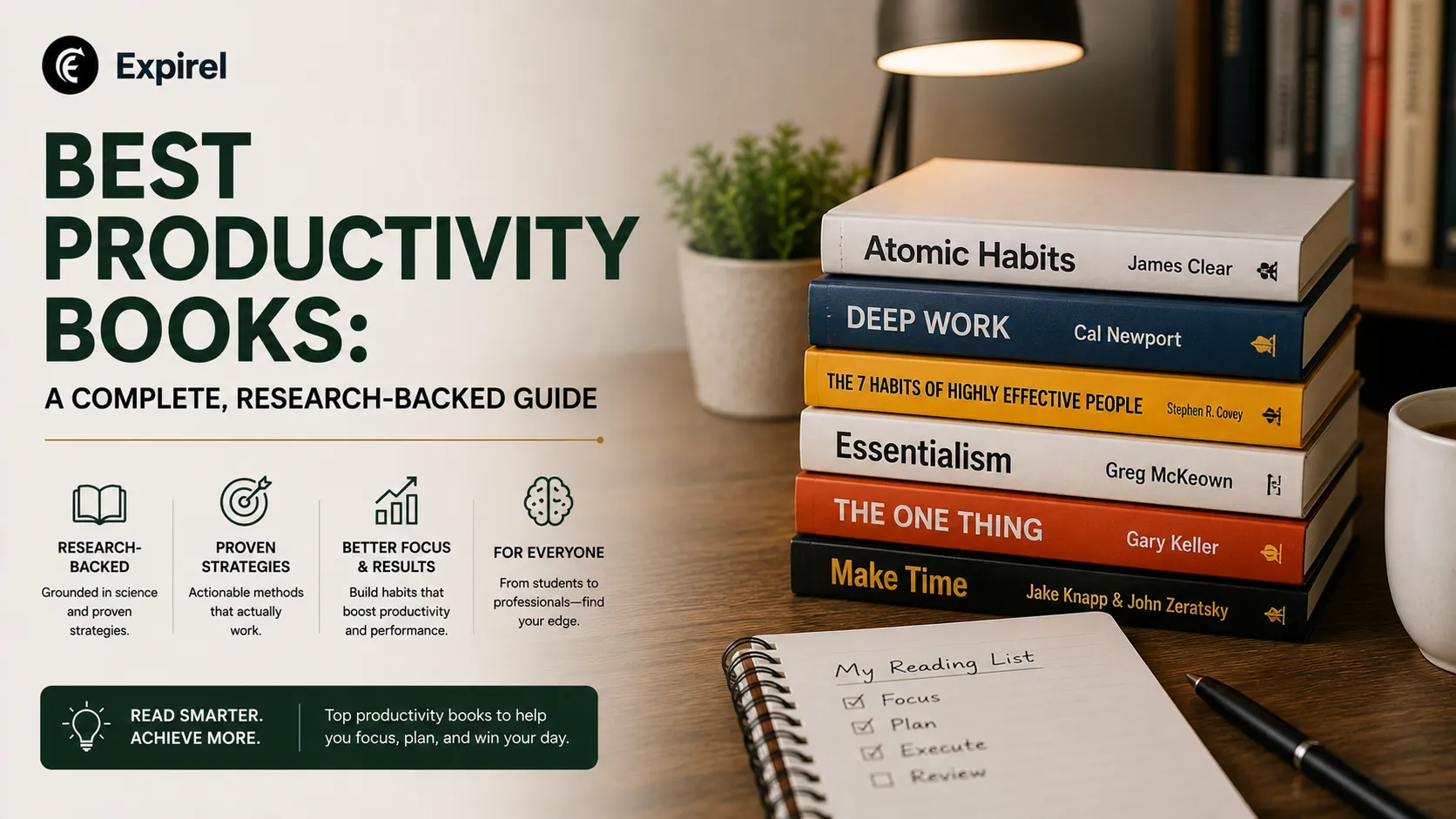
Searching for the best productivity books usually starts after a smaller, more specific problem: a to-do list that never empties, a habit that will not stick, or a workday that feels busy without feeling productive. The right book depends on which of those problems you actually have, which is exactly what most roundup lists skip. They rank books by popularity instead of by the specific bottleneck each one solves.
This guide fixes that. It groups the best productivity books of all time by the problem they solve, covers dedicated picks for students, teens, women balancing multiple roles, and ADHD brains, and tells you honestly where to find each one, on Kindle Unlimited, Audible, or otherwise. If you want the practical system these books point toward, rather than the reading list, our companion guide on the productivity recipe turns the ideas below into a daily framework you can actually run.
Best Productivity Books by Situation
Situation | Best Pick | Why |
|---|---|---|
Best overall/new to the genre | Atomic Habits | Most accessible entry point; over 1.3 million Goodreads ratings, the highest of any book on this list |
Best for a complete task system | Getting Things Done | The most detailed, air-tight capture and organization method available |
Best for deep focus and attention | Deep Work | Reframes attention itself as the scarce resource of modern work |
Best for prioritization | The ONE Thing | A single filtering question that cuts through an overloaded task list |
Best for ADHD | How to Keep House While Drowning | Written by a therapist with ADHD; removes shame from unfinished tasks rather than adding more systems |
Best for students | Atomic Habits | Directly applicable to study routines, and the shortest path to a first working habit |
Best for teens | Eat That Frog! | Short, direct chapters that do not require prior productivity vocabulary |
Best for a philosophy shift, not just tactics | Four Thousand Weeks | Challenges the idea that better productivity should mean doing more |
Best on Audible | Atomic Habits or Deep Work | Both run under 8 hours, suited to a single commute cycle |
How These Books Were Chosen
Four filters decided this list: the book had to offer a specific, repeatable framework rather than motivational language alone, it had to have a large enough reader base on Goodreads to confirm real-world staying power rather than a marketing push, it had to solve a distinct problem not already covered by another entry, and it had to still be actively recommended by readers years after publication, not just in its launch year. Books that only offered inspiration without a method, however popular, were left off.
The Best Productivity Books of All Time
Atomic Habits, by James Clear
Atomic Habits holds an average rating of 4.32 across more than 1.3 million Goodreads ratings, the largest reader base of any book on this list by a wide margin. Its core idea, that identity change drives habit change more reliably than willpower, is the reason it works as an entry point: it gives you a mechanism for consistency before asking you to adopt a whole task-management system. Start here if you have tried and abandoned other productivity systems before, since the real problem was usually the habit of using the system, not the system itself.
Getting Things Done, by David Allen
First published in 2001 and still holding a 4.0 average across more than 165,000 Goodreads ratings, GTD remains the most complete task-capture and organization method in the genre. Its five-step method, capture, clarify, organize, reflect, engage, is more detailed than almost any competing book, which is both its strength and its barrier to entry. Readers who finish GTD tend to either adopt it permanently or abandon it in the first two weeks, with little middle ground, which is why it suits people who want a full system handed to them rather than building one from scratch.
Deep Work, by Cal Newport
Deep Work holds a 4.16 average across nearly 193,000 ratings and reframes the core problem of modern knowledge work: Newport's argument is that sustained, undistracted concentration on hard cognitive tasks has become genuinely uncommon in most workplaces, which is exactly what makes it valuable to whoever still has it. Where GTD organizes what you do, Deep Work argues for protecting long, uninterrupted blocks so the work itself gets done at a higher level. It pairs naturally with a time-blocking approach, since the book's central argument only works if you actually schedule the focus blocks it describes, rather than intending to find the time.
The ONE Thing, by Gary Keller
This book's entire contribution is a single question: what is the one thing you can do such that, by doing it, everything else becomes easier or unnecessary? That question is deceptively hard to answer honestly, and readers who take it seriously often find it reorganizes a cluttered priority list faster than any app or planner could. It works best as a weekly filtering exercise rather than a daily one.
Four Thousand Weeks, by Oliver Burkeman
Most productivity books assume more output is always the goal. Four Thousand Weeks argues the opposite: given roughly four thousand weeks in an average life, the goal is not to fit more in, but to choose deliberately what gets left out. This book belongs on the list specifically because it is the corrective to reading too many of the other books on it. If Atomic Habits and GTD make you want to optimize everything, this is the book that asks whether everything is worth optimizing.
Best Productivity Books for Students
Students have a narrower, more time-boxed version of the productivity problem: a semester with fixed deadlines, competing subjects, and much less flexibility to build an elaborate system from scratch. Atomic Habits works well here because its unit of change, a small, specific habit tied to an existing routine, maps directly onto study sessions: review flashcards right after a specific class, not "study more." Eat That Frog!, by Brian Tracy, is a strong second pick for students specifically because it is short and built around a single tactic, doing the hardest task first, rather than a multi-week system to learn before it pays off.
Best Productivity Books for Teens
For teens, the bar is different again: the book needs to work without assuming a full-time job, a mortgage, or a team to manage. Eat That Frog! remains a strong pick here for the same reason it works for students, short chapters and one core tactic. Atomic Habits also reads well for teens because its examples lean on personal identity and self-image, a genuinely motivating frame at that age, more than career or business examples would be.
Best Productivity Books for ADHD
Standard productivity books, including several on this list, are frequently written for a neurotypical brain, which assumes consistent motivation and linear follow-through. That assumption breaks down for ADHD readers, and the best books for this audience know it. How to Keep House While Drowning, by therapist KC Davis, holds a 4.21 average across nearly 75,000 ratings and approaches the problem from an entirely different angle: removing the shame attached to unfinished tasks before adding any new system. Davis has ADHD herself, which shows in how the book treats inconsistency as expected rather than a personal failure.
Extra Focus, by Jesse J. Anderson, and HyperFocus are two more recent additions written specifically by and for adults with ADHD, both focused on working with an ADHD brain's actual attention patterns rather than forcing a neurotypical system onto it. The practical lesson across all of these: if you have tried GTD or a dated planner multiple times and abandoned it each time, the honest next step is a book written for how your brain actually works, not a stricter version of the same system.
Best Productivity Books for Women Managing Multiple Roles
This search term usually reflects a specific situation rather than a gendered book category: someone juggling a career alongside a disproportionate share of household and caregiving responsibility, where generic workplace productivity advice does not account for the second, unpaid workload. Four Thousand Weeks is a strong fit here precisely because it questions the premise that doing more is the goal, which resonates differently for a reader already stretched across two full workloads. How to Keep House While Drowning also applies well beyond ADHD specifically, since its central argument, that unfinished household tasks are not a moral failing, speaks directly to the guilt that often accompanies this exact situation.
Where to Find These Books: Kindle Unlimited, Audible, and Goodreads
On Kindle Unlimited
Kindle Unlimited's catalog changes over time as publishing licenses shift, so the most reliable approach is checking availability directly in the Kindle Unlimited catalog before assuming a specific title is included, since backlist self-help titles move in and out of the program more often than most readers expect.
On Audible
Deep Work and Atomic Habits are both well suited to audio, and both run under eight hours, short enough to finish in a single week of a normal commute. GTD's audio edition works less well as a first read for the method, since the book's five-step system benefits from being able to flip back to a specific page while actually setting up your own system, something audio makes harder.
On Goodreads
Goodreads ratings are most useful as a floor, not a ranking. A book with a 4.3 average and 1.3 million ratings and a book with a 4.2 average and 75,000 ratings are both well past the threshold where the rating reflects real reader consensus rather than noise. Below a few thousand ratings, treat the average with more caution, since a small early audience can skew a rating in either direction.
What Reddit Communities Actually Recommend
Productivity-focused subreddits circulate the same handful of titles repeatedly, and Atomic Habits, Deep Work, and Getting Things Done dominate nearly every "best productivity book" thread for good reason: they solve genuinely different problems, habit formation, focus, and organization, rather than competing for the same one. Where these threads add real value beyond a bookstore list is the recurring warning against reading five productivity books back to back without implementing any of them. The most repeated piece of advice across these communities is to finish one book, apply its central method for a month, and only then decide whether a second book's system is worth adding on top.
A Framework for Choosing Your Next Productivity Book
Name your actual bottleneck first: task capture, focus, prioritization, habit consistency, or motivation itself. A book chosen without this step usually gets abandoned by chapter three.
Match the bottleneck to the right book: GTD for capture and organization, Deep Work for focus, The ONE Thing for prioritization, Atomic Habits for consistency, Four Thousand Weeks if the real issue is doing too much rather than too little.
Read one book at a time, not three in parallel. Competing frameworks in your head at once is a common reason none of them stick.
Apply the core method for at least three weeks before judging whether it works, since most of these systems are explicitly designed to compound rather than deliver results immediately.
Only add a second book once the first system is running on its own, rather than replacing an unfinished system with a new one every few weeks.
Common Mistakes People Make With Productivity Books
Reading for inspiration instead of implementation, then feeling motivated for a week and reverting to the same habits once the book is finished.
Buying a new productivity book every time the current system stalls, rather than troubleshooting why the current one stalled in the first place.
Trying to run GTD and Atomic Habits and The ONE Thing simultaneously, when each book expects to be the primary system, not one of three competing for the same fifteen minutes of morning planning.
Choosing a book based on general popularity rather than the specific bottleneck it addresses, then blaming the book when it does not fix an unrelated problem.
From Reading to Doing: Turning a Book Into a System
Every book on this list eventually asks the same thing of the reader: track something consistently, whether that is a habit streak in Atomic Habits, a capture inbox in GTD, or a daily deep work block in Newport's system. The book supplies the idea; a tracking habit is what actually turns it into a result. A visual habit tracker, like the one built into Expirel, lets you log whichever method you choose, a daily habit streak, a completed deep work block, a finished weekly review as its own trackable item, so you can see in a week or a month whether the book's method is actually sticking, rather than relying on memory to judge it.
The same tracking principle holds outside of book habits too. If you're running a job search as a weekly system, the idea is identical: log the action, review weekly, and adjust based on what the numbers actually show, rather than how the week felt.
If your productivity system also needs to account for recurring, date-based obligations, subscriptions, renewals, or a family member's schedule, Expirel expiry tracker and family sharing features keep those separate from the daily habit work, which matters because mixing one-off tasks with recurring obligations is one of the most common reasons a freshly built system, from any book on this list, gets cluttered and abandoned within a month.
Conclusion
The best productivity book is not the most popular one. It is the one that matches your actual bottleneck: capture and organization, sustained focus, consistent habits, ruthless prioritization, or simply doing less. Start with Atomic Habits if you need a starting point, Getting Things Done if you need a full system, Deep Work if your problem is attention, or How to Keep House While Drowning if a standard productivity book has never once accounted for how your brain actually works. Whichever one you choose, read it to implement, not just to finish, and give the method a real few weeks before deciding whether it earns a permanent place in your routine.
Frequently Asked Questions
Q: What are the best productivity books of all time?
Atomic Habits, Getting Things Done, Deep Work, The ONE Thing, and Four Thousand Weeks are consistently ranked among the best productivity books of all time, each solving a distinct problem: habit consistency, task organization, focus, prioritization, and the philosophy of doing less but better.
Q: What are the best productivity books for 2026?
The core list has stayed stable year over year because these books solve foundational problems rather than trend-driven ones. Atomic Habits, Deep Work, and Getting Things Done remain the most recommended entry points heading into 2026, alongside newer ADHD-specific titles like Extra Focus.
Q: What is the best productivity book for ADHD?
How to Keep House While Drowning by KC Davis is the most widely recommended starting point, since it removes the shame around unfinished tasks before introducing any system. Extra Focus and HyperFocus are strong follow-ups written specifically for adult ADHD readers.
Q: What productivity books are available on Audible and Kindle Unlimited?
Deep Work and Atomic Habits both work well on Audible, running under eight hours with strong narration. Kindle Unlimited's catalog shifts over time, so checking current availability directly in the app before assuming a specific title is included is the most reliable approach.
Q: What do Reddit productivity communities recommend most?
Atomic Habits, Deep Work, and Getting Things Done dominate most recommendation threads, alongside a recurring warning against reading multiple productivity books back to back without implementing any single method first.

Fahad Ahmad
Founder of EXPIREL · Digital Entrepreneur · Product Management Specialist
Fahad Ahmad is the founder of EXPIREL and a digital entrepreneur with over 10 years of experience in SaaS development, SEO, and digital product creation. He focuses on building practical solutions that help individuals and businesses manage product expiration dates, organize inventory, track habits, and improve daily productivity.
Through EXPIREL, Fahad shares actionable guides, product management tips, barcode scanning tutorials, and research-backed insights designed to help users reduce waste, stay organized, and make smarter decisions.
Related Articles
View all
Best Productivity Planners: A Research-Backed Guide for 2026
July 21, 2026
Which productivity planner actually fits how you work? Compare 15 top picks for ADHD, iPad, work, and paper by price, pros, and cons.
AI Chatbot for Productivity: Complete 2026 Guide: Research, Pricing, and Which One Actually Works for You
September 29, 2026
Verified 2026 pricing, peer-reviewed research, and honest comparisons of the best AI chatbots for productivity, customer service, and website engagement.
11 Best Social Media Productivity Tools to Save Time in 2026
October 12, 2026
Compare 11 social media productivity tools for 2026 that save time on routines, scheduling, design, automation, video, analytics, and link tracking.