What Habits Kill a Human Slowly? 12 Patterns Research Has Linked to Early Death and How to Stop Each One
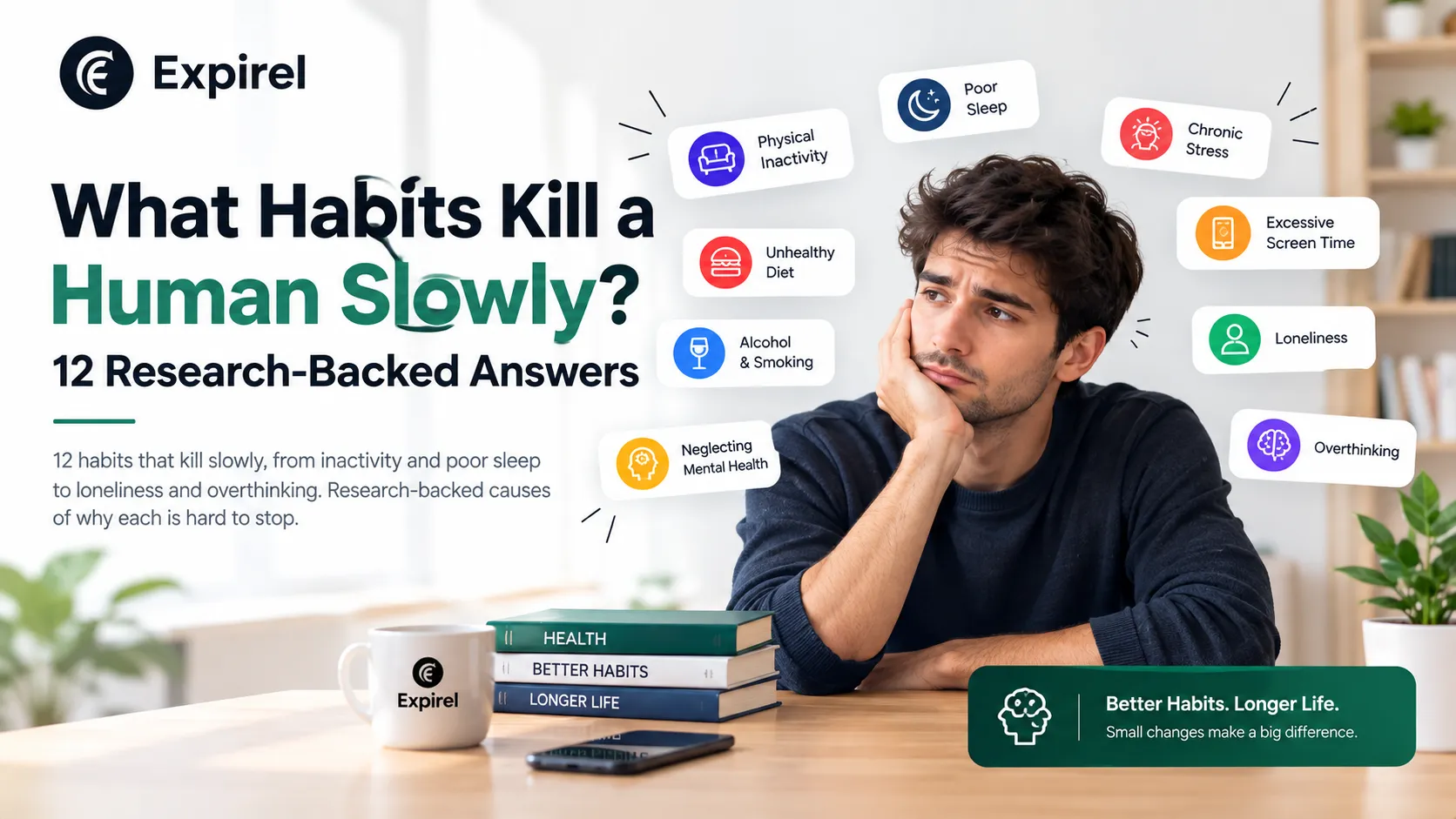
12 habits that kill slowly, from inactivity and poor sleep to loneliness and overthinking. Research-backed causes of why each is hard to stop.
Important: This article is educational, not medical advice
The habits and health information in this article are for general educational purposes only and are not a substitute for professional medical advice, diagnosis, or treatment. If you are concerned about any of the habits described here as they relate to your health, consult a qualified healthcare professional.
The most dangerous habits are not the dramatic ones. They are the ones that feel normal. The ones that have been present so long you stopped noticing them. The ones that kill slowly through accumulation, through compounding, through the gap between how you actually feel today and how you would feel if you had been living differently for the past decade.
This article answers the question directly: what habits kill a human slowly? Not with vague warnings but with the specific research behind each habit, the real reason it is hard to stop, and one concrete action you can take on each one today. Twelve habits are covered some physical, some mental, some behavioral all of them common, all of them underestimated.
If you recognise yourself in three or more of these, that is not a reason to panic. It is a reason to pick the one that is costing you the most and start there.
The habits that kill a human slowly include physical patterns (physical inactivity, poor sleep, excess sugar and processed food, smoking, heavy alcohol consumption, chronic dehydration, and prolonged daily sitting) and psychological ones (chronic stress without management, social isolation, overthinking, excessive passive social media use, and ignoring preventive healthcare). The danger is not any single habit but their cumulative effect over years each one accelerates the damage of the others. The fix for most of them is the same: one specific replacement behavior practiced daily until it is automatic.
Why Slow-Killing Habits Are Harder to Break Than Obvious Ones
A habit that causes immediate harm is easy to identify. You burn your hand on a stove and you do not touch it again. A habit that causes harm across decades offers no such feedback. You sit for 10 hours today and feel fine. You eat poorly this week and feel broadly normal. You sleep badly for a month and adjust to the fog so completely you stop registering it as impairment.
This is the normalization trap. The body's extraordinary capacity for adaptation the same capacity that helps you survive hardship also allows you to adapt to conditions that are slowly degrading your health, your cognition, and your life expectancy. You adapt to the damage and stop counting it as damage.
The research on this is consistent across multiple disciplines. In a landmark 2012 analysis published in the journal Preventive Medicine, researchers found that the clustering of multiple unhealthy behaviors (physical inactivity, poor diet, smoking, and excessive alcohol) was associated with a fourfold increase in premature mortality risk compared to any single behavior alone. The habits compound each other. A sedentary lifestyle makes sleep worse. Poor sleep increases sugar cravings. Excess sugar contributes to weight gain. Weight gain reduces motivation to move. The cycle accelerates quietly over years.
Slow-killing habits are dangerous not because each one is catastrophic but because they reinforce each other and normalize progressively worse baselines. You stop comparing yourself to how you could feel and start comparing yourself to yesterday.
Physical Habits That Kill Slowly: What the Research Actually Says
1: Physical Inactivity
The science: The World Health Organization identifies physical inactivity as the fourth leading risk factor for global mortality, responsible for an estimated 3.2 million deaths annually. A 2012 meta-analysis published in The Lancet calculated that physical inactivity causes 6 to 10 percent of the major non-communicable diseases globally including coronary heart disease, type 2 diabetes, and certain cancers.
Why it is easy to ignore: Exercise has no immediate reward that matches the immediate reward of not exercising. Rest feels productive when you are tired. The benefits of activity compound over months and years exactly the timeframe human brains are worst at weighting against present comfort.
One specific fix: Walk 30 minutes every day before you add any other exercise. Not a gym membership, not a programme, 30 minutes of walking. Research from the Harvard Medical School publication Harvard Health consistently identifies brisk walking as one of the most accessible and well-evidenced interventions for cardiovascular health and longevity.
2: Chronic Sleep Deprivation
The science: Sleep researcher Matthew Walker, Professor of Neuroscience at UC Berkeley, documented in peer-reviewed literature and his 2017 book Why We Sleep (published by Scribner) that sleeping fewer than 6 hours per night is associated with significantly elevated risks of cardiovascular disease, metabolic disorders, immune suppression, and cognitive decline. The WHO has declared sleep deprivation a public health epidemic in industrialised nations.
Why it is easy to ignore: Sleep loss accumulates without obvious daily markers. You adjust to 5 or 6 hours and stop recognising the cognitive impairment because your baseline has shifted. Studies on sleep restriction consistently find that sleep-deprived people dramatically underestimate their own cognitive impairment the very system you would use to assess the damage is the system that is damaged.
One specific fix: Set a consistent sleep time same time every night including weekends for 21 days before changing anything else about your sleep environment. Consistency of sleep and wake time is the single highest-impact change in sleep quality, ahead of temperature, light, and supplementation.
3: Excess Sugar and Ultra-Processed Food
The science: A 2019 study published in JAMA Internal Medicine by Schnabel et al. found that a 10 percent increase in ultra-processed food consumption was associated with a 14 percent higher risk of all-cause mortality. The American Heart Association links high added sugar consumption to increased rates of cardiovascular disease, type 2 diabetes, and obesity.
Why it is easy to ignore: Sugar is engineered to overcome your satiety signals. Ultra-processed foods are specifically formulated to maximize palatability they are not competing with vegetables on your preference scale. They are competing by bypassing the preference system entirely and triggering reward circuitry directly. The habit feels like preference. It is closer to a designed compulsion.
One specific fix: Remove ultra-processed food from your home environment first. Do not rely on willpower at the moment of temptation rely on not having the product accessible. This is an environment design fix, not a discipline fix. What is not in your house cannot be eaten in a weak moment.
4: Smoking and Heavy Alcohol Consumption
The science: Smoking causes approximately 8 million deaths per year globally according to WHO data. It is the leading cause of preventable death in most developed countries and reduces average life expectancy by 10 years in sustained smokers. Heavy alcohol consumption (more than 14 units per week for women or 21 for men, per NHS guidelines) is associated with liver disease, cardiovascular disease, and at least seven forms of cancer including breast and bowel cancer.
Why it is easy to ignore: Both are highly normalised socially, both involve physical dependency that makes quitting significantly harder than starting, and both carry strong identity associations that make change feel like loss rather than gain.
One specific fix: For smoking: the most evidence-backed cessation method according to the NHS and NICE guidance combines nicotine replacement therapy with behavioural support not willpower alone. For alcohol: the NHS Alcohol Units calculator gives a baseline for where your intake sits relative to recommended limits before any change attempt.
5: Prolonged Daily Sitting
The science: A 2012 study published in BMJ Open found that reducing sitting time to under 3 hours per day could increase life expectancy by 2 years. Separate research from the American Cancer Society found that women who sat more than 6 hours per day had a 37 percent higher death rate than those who sat fewer than 3 hours independent of exercise habits. Sitting activates different metabolic pathways than inactivity during sleep and is a distinct risk from simply 'not exercising enough.'
Why it is easy to ignore: Knowledge workers sit for 8 to 12 hours daily as a structural feature of their work, not a lifestyle choice. Exercise before or after does not fully offset the metabolic effects of prolonged seated posture during the working day. Most people are aware of this and do nothing because the fix feels impractical during a working day.
One specific fix: Set a phone reminder every 50 to 60 minutes to stand and move for 2 minutes. Not a full walk two minutes. Research on prolonged sitting consistently finds that brief, regular interruptions to sitting posture reduce metabolic risk markers more effectively than one extended exercise session that sandwiches 8 hours of sitting.
6: Chronic Dehydration
The science: The human body is approximately 60 percent water. Even mild dehydration of 1 to 2 percent of body weight has been shown in multiple studies to impair cognitive function, increase kidney stress, and reduce physical performance. Chronic mild dehydration over years is associated with increased risk of kidney stones, urinary tract conditions, and impaired thermoregulation.
Why it is easy to ignore: Thirst is a late signal of dehydration by the time you feel thirsty, you are already mildly dehydrated. People who work in air-conditioned offices, drink caffeine, and exercise rarely often maintain a state of mild chronic dehydration without ever feeling acutely thirsty. The impairment becomes the new normal.
One specific fix: Drink one full glass of water before each meal and one immediately after waking. This creates three fixed hydration triggers daily requiring no monitoring or tracking. Do not rely on thirst as the signal use the meal anchors instead.
Mental and Psychological Habits That Kill Slowly
The loneliness research: a surprising finding
A 2015 meta-analysis by Holt-Lunstad, Smith, Baker, Harris and Stephenson published in PLOS Medicine analysed 70 studies covering over 3.4 million participants. It found that social isolation, loneliness, and living alone increased mortality risk by 26, 29, and 32 percent respectively — figures comparable to the mortality risk from smoking 15 cigarettes per day. The researchers concluded that social connection deserves the same public health priority as physical risk factors. This finding has been replicated in multiple subsequent studies across different populations and age groups.
7: Social Isolation and Loneliness
The science: The Holt-Lunstad et al. (2015) meta-analysis cited above found that loneliness and social isolation increase mortality risk by approximately 26 to 32 percent comparable in scale to established physical risk factors. The biological mechanisms include elevated cortisol levels, impaired immune function, disrupted sleep, and increased inflammatory markers in chronically isolated individuals.
Why it is easy to ignore: Modern life structurally reduces social contact. Remote work, urban living, commuting, screen time, and the replacement of in-person interaction with digital communication all reduce the frequency and depth of genuine human connection. Social isolation does not always feel lonely it often feels like busyness, introversion, or preference for independence.
One specific fix: Make one direct personal contact per day a phone call, a meeting, a genuine conversation as a non-negotiable daily minimum. Not a text message. Not a like. A conversation with a real person. The research on social connection and health outcomes is consistent: quantity and frequency of direct interaction matter, not just the quality of occasional deep contact.
8: Chronic Stress Without Management
The science: The American Psychological Association documents that chronic stress elevates cortisol levels, which over time suppresses immune function, disrupts sleep architecture, increases blood pressure, contributes to weight gain particularly around the abdomen, and accelerates cellular aging through telomere shortening. A 2012 study in Current Directions in Psychological Science found chronic stress was linked to higher rates of cardiovascular disease, diabetes, and depression.
Why it is easy to ignore: Chronic stress is often worn as a badge of productivity. Busy people treat stress as evidence of importance. Many people cannot distinguish between the acute stress that improves performance (eustress) and the chronic background stress that degrades health because both feel like the same sensation of urgency.
One specific fix: Identify your specific primary stress source and name it. Not 'work' something specific: 'I do not know what my manager thinks of my performance' or 'I have not resolved the conversation from three weeks ago.' Vague stress is harder to manage than named stress. Once named, it either has an action attached to it or it does not. Actions reduce stress. Rumination on unnamed stress does not.
9: Chronic Overthinking and Rumination
The science: Research on rumination — the repetitive mental review of past events, problems, and concerns — consistently links it to elevated rates of depression, anxiety, insomnia, and cardiovascular stress response. A 2013 study in JAMA Internal Medicine found that excessive worry and rumination were independently associated with higher mortality risk in older adults, independent of diagnosed mental health conditions.
Why it is easy to ignore: Overthinking feels like problem-solving. It uses the same mental vocabulary as planning and analysis. The distinction — that productive thinking reaches conclusions while rumination loops without resolution — is hard to identify from the inside because both feel like work.
One specific fix: Use a physical boundary to contain rumination: schedule a specific 15-minute 'worry window' each day (same time, same location). When a ruminative thought appears outside that window, note it and defer it to the window. This cognitive behavioral technique is documented in clinical research as effective for reducing uncontrolled rumination without suppressing it.
10 Excessive Passive Social Media Consumption
The science: Multiple studies distinguish between active social media use (creating, communicating) and passive use (scrolling, consuming). A 2018 study in the Journal of Social and Clinical Psychology found that passive social media use was associated with increased loneliness, depression, and anxiety. A 2022 review in World Psychiatry linked heavy social media use in adolescents to sleep disruption, body image issues, and reduced life satisfaction.
Why it is easy to ignore: Social media platforms are engineered for maximum attention capture using variable reward mechanisms identical to those used in slot machine design. The compulsive scrolling behavior is not a failure of willpower it is the expected output of a product designed by teams of engineers specifically to make stopping feel difficult.
One specific fix: Use Screen Time (iOS) or Digital Wellbeing (Android) to set a hard daily limit of 30 minutes for your highest-use social media app. Enable the 'Ignore limit' friction (require a passcode to override). The goal is not eliminating social media — it is converting passive consumption time into time you choose to spend, not time that gets extracted from you by default.
11 Ignoring Preventive Healthcare
The science: A 2019 analysis in the American Journal of Preventive Medicine found that individuals who engaged with regular preventive healthcare screenings blood pressure monitoring, cholesterol checks, cancer screenings, dental care had significantly lower rates of late-stage disease diagnosis. Many preventable deaths occur not because treatment was unavailable but because the condition was identified too late. Cardiovascular disease, type 2 diabetes, and certain cancers are all conditions where early identification dramatically improves outcome.
Why it is easy to ignore: Medical appointments feel unurgent when you feel broadly fine. People delay check-ups when they are busy, when they are anxious about potential findings, or when they have convinced themselves that the absence of acute symptoms means absence of problems. This is the most dangerous application of the normalization trap.
One specific fix: Schedule one overdue health screening this week regardless of how well you feel. Start with blood pressure if you have not had it checked in over a year — it is available free at most pharmacies and takes two minutes. High blood pressure is called a silent killer precisely because it produces no symptoms while causing progressive damage to blood vessels and organs.
12 Mental Stagnation: No Learning or Growth
The science: Cognitive reserve research the study of how mental activity protects against cognitive decline consistently finds that lifelong engagement with learning, reading, and novel mental challenges is associated with delayed onset of dementia and reduced cognitive decline in aging. A 2003 study in the New England Journal of Medicine found that cognitively stimulating activities such as reading, playing games, and solving puzzles were associated with a significantly reduced risk of developing Alzheimer's disease.
Why it is easy to ignore: Mental stagnation does not announce itself. It arrives as comfort with routine, preference for familiar content, reduced curiosity, and a gradual narrowing of the range of ideas and experiences you engage with. It feels like maturity. It is closer to atrophy.
One specific fix: Read 10 pages per day on a subject outside your current professional expertise. Not news a book on a topic you know nothing about. The 10-page daily minimum is low enough to survive a bad week and high enough to complete 10 to 12 books per year. The topic matters less than the regularity of encountering genuinely new ideas.
How to Address These Habits Without Overwhelm: A Practical Framework
Identifying 12 habits you may be doing wrong is useful. Trying to fix all 12 simultaneously is how people change nothing. Here is the practical framework for actually making progress.
Step 1: Identify Your Highest-Cost Habit
Read back through the 12 habits above. Which one, if improved, would have the most immediate positive effect on your daily quality of life? Not the most dramatic in theory the most relevant to your actual daily experience. That is your starting point.
Step 2: Define One Specific Replacement Behavior
Every slow killing habit is most effectively addressed by replacing it with a specific positive behavior anchored to an existing routine not by willpower-based suppression. 'Stop scrolling' is not a replacement behavior. 'Set a 30-minute Screen Time limit before I open the app each morning' is. 'Exercise more' is not a replacement behavior. 'Walk 30 minutes after breakfast before I open my laptop' is. The specificity is the mechanism.
Step 3: Track One Replacement Habit for 21 Days Before Adding Another
Research on habit formation consistently shows that building one habit at a time produces better long-term adherence than attempting multiple simultaneous changes. Twenty-one days is not the universal number for habit automaticity that figure varies significantly by person and behavior complexity but it is a reasonable minimum before evaluating whether the behavior has stabilized enough to layer a second change on top.
Track your replacement habits with Expirel
The most common reason replacement habits fail is that they exist only as intentions rather than tracked commitments. Expirel's Habit Tracker is designed for exactly this use case: logging one specific replacement behavior per slow-killing habit, maintaining a visible streak that makes breaking the chain feel like a genuine cost, and reviewing your weekly pattern to see which habits are holding and which need adjustment. Start with one habit your highest-cost slow-killing pattern and track the replacement daily for 21 days before adding a second.
Conclusion
The question 'what habits kill a human slowly?' does not have a single dramatic answer. The honest answer is: ordinary habits, widely shared, poorly monitored, and normalized over years. Physical inactivity. Poor sleep. Too much sugar and processed food. Too little genuine human connection. Too much passive digital consumption. Chronic stress that never gets named or addressed. Preventive health that keeps getting postponed.
None of these kill you today. That is why they are so easy to continue. But the compounding effect across a decade or two is not gradual it is exponential, because each habit reinforces the others. Poor sleep increases sugar cravings. Sugar increases weight. Weight reduces motivation to exercise. Reduced exercise worsens sleep. The loop accelerates quietly.
The fix is not dramatic either. It is identifying the one habit costing you the most right now, defining one specific replacement behavior, anchoring it to something you already do, and tracking it visibly until it is automatic. Then moving to the next one. That is the entire method. It works because it does not depend on motivation, inspiration, or a perfect week. It depends on structure and structure survives the weeks when nothing else does.
Frequently Asked Questions
Q: What habits kill a human slowly?
The habits most consistently linked to premature death by research are physical inactivity, chronic sleep deprivation, excess sugar and ultra-processed food, smoking, heavy alcohol consumption, prolonged daily sitting, chronic dehydration, social isolation, chronic unmanaged stress, overthinking and rumination, excessive passive social media use, ignoring preventive healthcare, and mental stagnation. The greatest risk comes from clustering multiple habits each one accelerates the damage of the others through compounding physiological and psychological effects.
Q: Which slow-killing habit is the most dangerous?
Research does not rank a single habit as universally most dangerous because the impact varies significantly by individual health profile, genetics, and existing conditions. However, physical inactivity is identified by the WHO as the fourth leading risk factor for global mortality. Chronic sleep deprivation and social isolation are increasingly recognised as carrying mortality risks comparable in scale to smoking. For most individuals in desk-based working environments, the combination of physical inactivity, poor sleep, and social isolation is the highest-risk cluster.
Q: Can the damage from slow-killing habits be reversed?
Many of the health effects of slow-killing habits are partially or fully reversible with sustained behavior change, particularly for younger people and those who have not yet developed chronic conditions. Cardiovascular risk from inactivity decreases within weeks of regular walking. Sleep quality improves within days of consistent sleep timing. Cognitive benefits of social engagement appear relatively quickly. The key word is sustained single improvements that are not maintained produce limited lasting benefit.
Q: How does overthinking kill you slowly?
Chronic overthinking and rumination maintain the body in a state of low-grade stress response, keeping cortisol and inflammatory markers elevated. Over time, this contributes to impaired immune function, disrupted sleep, increased cardiovascular disease risk, and elevated rates of anxiety and depression. Research published in JAMA Internal Medicine found excessive worry and rumination were independently associated with higher mortality risk in older adults. The mechanism is cumulative: the damage is not from any single rumination episode but from years of sustained elevated stress response.
Q: Is social media slowly killing people?
Passive social media consumption scrolling and consuming without creating or communicating is associated with increased loneliness, sleep disruption, depression, and anxiety in multiple peer-reviewed studies. The 2022 World Psychiatry review found significant associations between heavy use and mental health deterioration particularly in younger users. The mechanism involves disrupted sleep (screen light and stimulation before bed), social comparison effects on self-worth, and the displacement of restorative activities including exercise, sleep, and real human connection.
Q: How much sitting is too much per day?
Research published in BMJ Open found that sitting more than 3 hours per day was associated with measurably reduced life expectancy. The American Cancer Society research found mortality risk increases significantly beyond 6 hours of daily sitting, independent of other exercise habits. Most knowledge workers sit between 8 and 12 hours daily. The most effective intervention is not one exercise session but frequent brief interruptions to sitting standing or moving for 2 minutes every 50 to 60 minutes which interrupts the metabolic cascade that prolonged sitting activates.
Q: Does loneliness really shorten life expectancy?
Yes. The Holt-Lunstad et al. (2015) meta-analysis in PLOS Medicine one of the most cited studies in social health research, covering 3.4 million participants across 70 studies found that loneliness and social isolation increased mortality risk by 26 to 32 percent. This is comparable in magnitude to the mortality risk from smoking. The WHO has identified loneliness as a significant global health issue, and the UK appointed a Minister for Loneliness in 2018 in response to the documented public health impact.
Q: What is the most effective way to break a slow-killing habit?
The most evidence-supported approach combines three elements: identifying one specific habit to change first rather than attempting multiple simultaneously, defining a specific replacement behavior anchored to an existing daily routine rather than relying on motivation-based suppression, and tracking the replacement behavior with a visible streak for a minimum of 21 days before evaluating progress or adding a second change. The replacement and tracking combination is the standard behavioral intervention used in clinical habit change research.
Q: How does poor sleep kill you slowly?
Chronic sleep deprivation consistently sleeping fewer than 6 to 7 hours per night has been linked to elevated risks of cardiovascular disease, type 2 diabetes, obesity, immune suppression, and accelerated cognitive decline. Sleep researcher Matthew Walker at UC Berkeley has documented that the brain's glymphatic system which clears metabolic waste from neural tissue operates primarily during deep sleep. Chronic sleep restriction impairs this clearing process, with implications for long-term neurological health. The full mechanism is covered in the sleep section of this guide.

Fahad Ahmad
Founder of EXPIREL · Digital Entrepreneur · Product Management Specialist
Fahad Ahmad is the founder of EXPIREL and a digital entrepreneur with over 10 years of experience in SaaS development, SEO, and digital product creation. He focuses on building practical solutions that help individuals and businesses manage product expiration dates, organize inventory, track habits, and improve daily productivity.
Through EXPIREL, Fahad shares actionable guides, product management tips, barcode scanning tutorials, and research-backed insights designed to help users reduce waste, stay organized, and make smarter decisions.
Related Articles
View all
AI Productivity Tools Update 2026–2027: What Works, What Changed, and What to Use Right Now
September 18, 2026
AI productivity tools in 2026 and heading into 2027. What they mainly reduce the best tools by role, free options, and how to evaluate any tool before adopting.
How to Track Habits: A Complete System for Building Habits That Actually Stick
August 3, 2026
Tired of abandoned habit trackers? Get a step-by-step system for daily, weekly, and long-term habits, plus a free 30-day checklist you can start today.

Productive Dinner: What to Eat, When to Stop, and 4 Easy Meals
July 19, 2026
A productive dinner supports sleep and next-day focus. Learn what to eat, when to stop eating, what to skip, and four quick meals under 30 minutes.